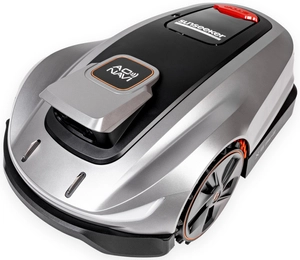
The Sunseeker Ecosystem – How to Integrate Automatic Mowing with Your Garden Watering Schedule?

A modern garden increasingly functions as a smart ecosystem in which individual devices work together, reducing the need for daily maintenance by the owner.Automatic irrigation, soil moisture sensors, and a robotic mower can work together to keep your lawn looking perfect all season long.However, to achieve the best results, it is essential to properly synchronize all skincare processes.
Many users wonder how to coordinate watering with a robotic lawn mower so that both systems work effectively and do not negatively affect the condition of the lawn.This is particularly important because an improperly set schedule can lead to mowing wet grass, the accumulation of compacted cuttings, and an increased risk of fungal diseases.Another question that arises is whether a robotic lawn mower can mow after watering and how long you should wait before letting the mower go back out onto the lawn.
The key to success is proper planning of the operation of both systems.Knowing when to water your lawn when using a robotic mower can not only improve the quality of the mowing but also enhance the effectiveness of mulching, reduce water consumption, and create optimal conditions for growing a thick, healthy lawn.In this article, we'll show you how to build a Smart Garden ecosystem based on Sunseeker robotic mowers and automatic irrigation, so your garden can practically take care of itself.
Table of Contents:
- What Is a Smart Garden Ecosystem, and Why Is a Robotic Lawn Mower Just the Beginning??
- Is it a problem if the robot mows wet grass after the sprinklers have been on??
- In what order should you mow and water to get the most out of your lawn??
- How to set up a mowing and watering schedule so they don't conflict?
- How to set up a robotic lawn mower so it doesn't mow wet grass?
- Is it worth having a soil moisture sensor on a mower??
- How much water and electricity does an automated garden really save compared to manual management??
What Is a Smart Garden Ecosystem, and Why Is a Robotic Lawn Mower Just the Beginning??
The modern smart garden is no longer just a collection of random gadgets controlled by separate apps.It is an advanced IoT (Internet of Things) ecosystem in which devices exchange information via the cloud, adjusting their operations based on weather conditions, soil moisture, and the time of day.
By introducing autonomous lawn mowing robots into your garden , you gain a powerful ally.Thanks to their advanced connectivity modules and intelligent space mapping, Sunseeker devices provide an excellent foundation for building an integrated Smart Garden system.A robotic lawn mower, however, is just the beginning.To fully unleash its regenerative potential (associated with micro-mulching), the machine must operate in perfect synergy with the automatic sprinkler system.It is only the combination of precise cutting and intelligent water distribution that creates a closed, self-sustaining biological cycle that radically transforms the appearance of the garden.
Is it a problem if the robot mows wet grass after the sprinklers have been on??
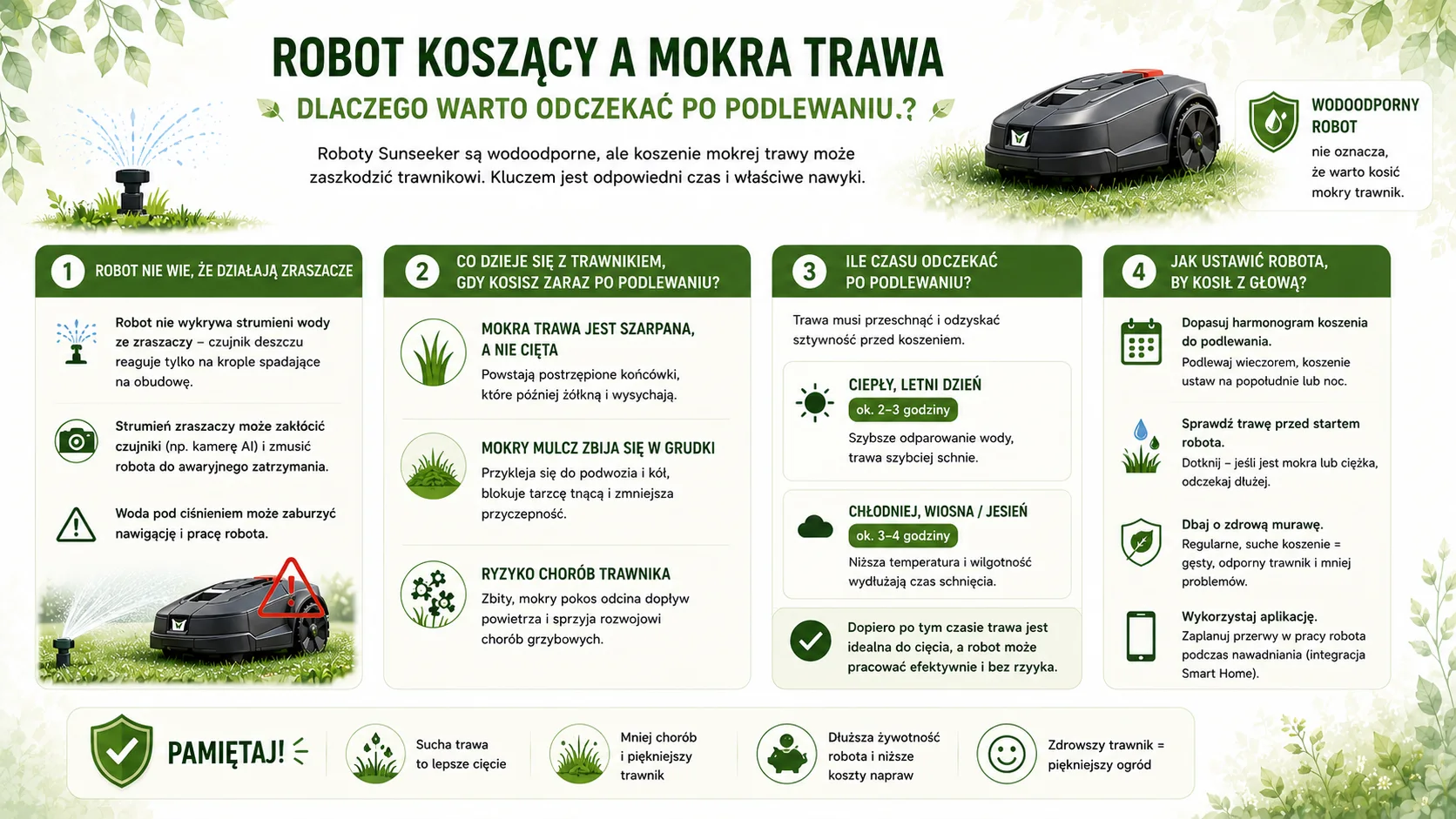
Many users of garden automation systems believe that, since modern robotic mowers are fully waterproof, they can operate without any problems in all conditions, including during rain or immediately after the sprinklers have been running.It is true that the mechanical and electronic components of Sunseeker robots are perfectly protected from moisture, but the key to success is not the machine’s durability, but the health of the turf itself.
Why doesn't the robotic lawn mower know that the sprinklers have just turned on??
A standard robotic lawn mower, unless integrated with a central irrigation controller via a smart home platform (such as Home Assistant or dedicated API scripts), does not have a built-in radar to detect water streams from sprinklers. Although it does have a rain sensor, it only activates when a sufficient number of raindrops hit the housing at the right angle.
Water sprayed from garden sprinklers very often misses the sensor on a robot that is either docked in its charging station or moving in another zone.When asking ourselves whether sprinklers interfere with a robotic lawn mower, we must keep in mind the risk of direct contact.A high-pressure water jet striking the optical sensors (e.g., a Vision AI camera) or the chassis of an operating robot directly can disrupt its navigation and force it to perform an emergency stop.
What happens to the lawn if the robot leaves right after watering??
When considering whether a robotic lawn mower can mow after watering, it’s worth taking a closer look at the physics of cutting wet grass.Wet grass is heavy, saturated with water, and tends to lie flat under the weight of the raindrops.When the robot drives onto a lawn like this, the blades don't cut the vertical blades of grass precisely; instead, they tug at them and crush them at an angle.This leads to the formation of frayed, white tips, which dry out after a few days, making the lawn look yellow and unkempt.
In addition, instead of settling freely onto the soil, wet micro-mulch clumps together into sticky lumps.These, in turn, stick to the robot's chassis, jamming the cutting disc and clogging the wheels, which drastically reduces the machine's traction.What’s more, compacted, wet clumps of grass left on the lawn block airflow, creating ideal conditions for the development of dangerous fungal diseases, such as snow mold or leaf spot.
How long should the robot wait after watering before resuming work??
To avoid these problems, the lawn must be dry before the robot starts mowing.This time depends on the ambient temperature, humidity, and the amount of sunlight.On a warm summer day, the grass regains its optimal elasticity and dryness after about 2 to 3 hours after the irrigation zones are turned off.During cooler seasons (spring, fall), this time may increase to 4 hours.Only after this time does the leaf blade regain its full turgor (stiffness), which allows Sunseeker blades to make a perfect, almost laser-like cut.
In what order should you mow and water to get the most out of your lawn??
In traditional gardening, where manual lawn mowers are used , the order of tasks is often random.In an automated garden, however, there is one strict rule: mow first, then water.
This system offers significant agronomic benefits:
- The Perfect Cut.The robot operates on a dry, springy lawn, allowing it to precisely trim each blade of grass and stimulate its growth.
- Better mulch distribution.The dry, fine clippings produced by the Sunseeker robot fall freely onto the ground.
- Instant Activation of Biomass.Sprinklers that turn on after mowing is complete wash the micro-mulch from the surface of the leaves directly into the soil.Water accelerates the breakdown of organic matter by microorganisms, turning cut grass into a free, nitrogen-rich fertilizer in just a dozen or so hours.
- Protection Against Thermal Stress.Watering immediately after mowing cools the cut plant tissues, minimizing the evaporation of cellular sap.
How to set up a mowing and watering schedule so they don't conflict?
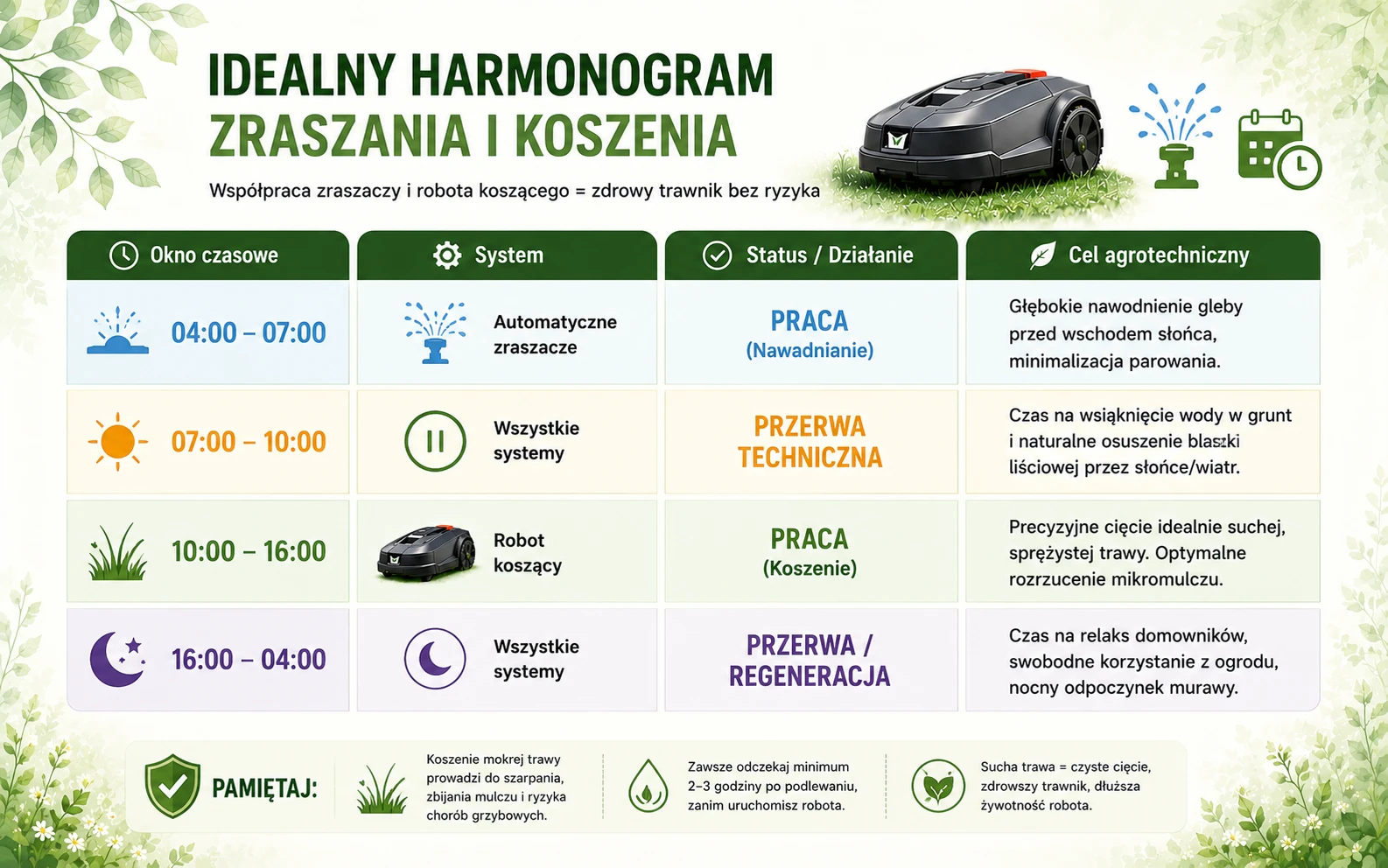
The key to seamless coordination between the two systems is a precise schedule for mowing and watering the lawn.The main rule is to completely separate the operating time slots for the sprinklers and the robotic mower.
We already know when to water the lawn with a robotic mower—the best time to water is in the early morning (between 4:00 and 7:00)..Watering at night promotes fungal diseases, while watering at midday results in massive water loss through evaporation and risks sunburn on the leaves.
The table below shows the optimal daily configuration for a smart garden during the summer.
How to set up a robotic lawn mower so it doesn't mow wet grass?
To ensure that the robot does not go out onto the lawn during or immediately after rain, you must activate the Rain Delay feature.When the sensor detects moisture, the robot stops operating or does not leave the base, and the countdown to restart begins only once the sensor is completely dry.It's a good idea to set this parameter to 120–180 minutes.
What should you do in an emergency situation when, due to a software error or a sudden change of plans, the robotic lawn mower has driven onto wet grass??
- Step 1.Immediately stop the machine using the app or the manual STOP button and return it to the docking station.
- Step 2.Turn off the robot's power (remove the safety key or lock it with a PIN).
- Step 3.Lay the robot on its side and thoroughly clean the cutting guard, blades, and wheels with a brush to remove any accumulated, sticky residue.Allowing it to dry out could cause the engine to seize up the next time it's started.
Is it worth having a soil moisture sensor on a mower??
The highest level of automation in a garden ecosystem is achieved by connecting digital soil moisture sensors to the network.Traditional irrigation controllers operate on a rigid schedule—they turn on the water regardless of whether the soil is dry or still saturated from yesterday’s downpour.
Smart sensors placed in key areas of the lawn continuously measure soil moisture and temperature.This data is sent directly to the Smart Home control center, which manages the schedules.
If the sensor detects that soil moisture exceeds 80%, the system will automatically cancel the morning watering.This information immediately adjusts the Sunseeker robot’s schedule—instead of waiting until 10:00 a.m. for the sprinklers to dry, the robot can safely leave the docking station earlier, optimizing battery life.The use of soil sensors eliminates the risk of overwatering the lawn, which is just as dangerous as letting it dry out.
How much water and electricity does an automated garden really save compared to manual management??
The integration of automated mowing with smart irrigation not only creates a spectacular visual effect but, above all, delivers tangible, quantifiable financial and resource savings.
- Water savings (up to 40%): The constant presence of micro-mulch generated by the Sunseeker robot creates an organic barrier on the soil surface that drastically reduces transpiration (evaporation of water from the soil).As a result, the lawn retains moisture in the root zone for much longer.When combined with a smart sprinkler controller that doesn't water the garden during or after rain, average water consumption over the course of a season drops by nearly $30–40\%$ compared to traditional, manual watering "by eye.".
- Energy and Equipment Savings: Brushless motors in robotic lawn mowers consume very little electricity (about 150 kWh per season for a 1,000 m² lawn).Since the robot cuts only dry, light grass, the resistance encountered by the blades is minimal.This results in lower battery power consumption during a single mowing cycle, slower wear on the cutting blades, and a longer battery life.The device runs for shorter periods, returns to the base less often, and the total cost of operating the Smart Garden is a fraction of what we would have to spend on fuel for a gas-powered mower and excess water.
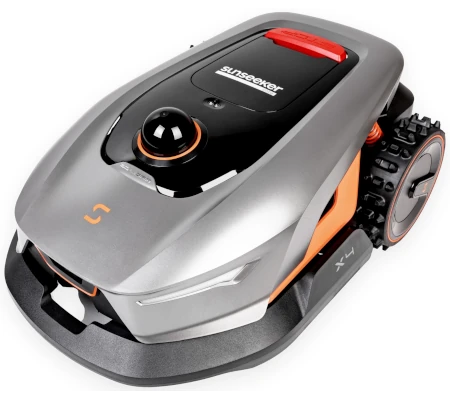
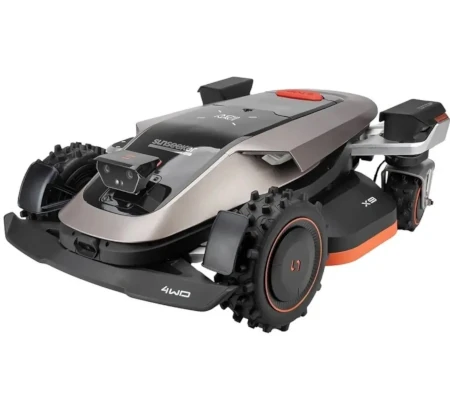
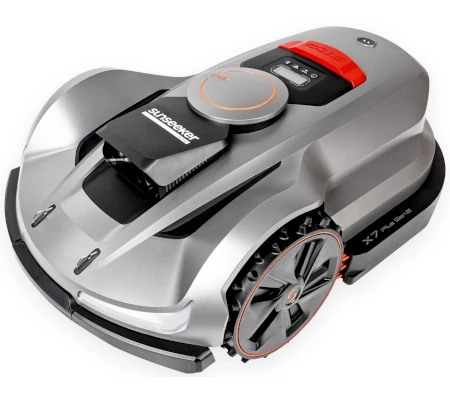
Building an integrated Smart Garden ecosystem is the key to having a perfect lawn that looks stunning all year round.The answer to the question of how to balance watering with a robotic mower lies in understanding the biological needs of the lawn and translating them into a digital schedule for the devices.Staggering mowing times, strictly avoiding mowing wet grass, and using advanced features—such as the rain delay function on Sunseeker mowers—ensure trouble-free operation and spectacularly thick grass..Garden automation is an investment that pays off every day—it frees you from tedious chores, optimizes the use of precious natural resources, and lets you enjoy immaculate, emerald-green lawns without any effort.
Recommended
SIRMEX SC36T ELECTRIC SHARING BRACKET SHARPS GUILLOTINES 32mm EWIMAX OFFICIAL DISTRIBUTOR - AUTHORIZED DEALER SIRMEX
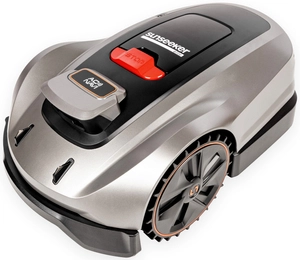
SUNSEEKER X3 CEDRUS X3 ELITE BY SUNSEEKER RTK AUTOMATIC MOWING ROBOT FOR CEDRUS C-MOW X3 800m2 WITHOUT CABLE / WITHOUT WIRELESS - OFFICIAL DISTRIBUTOR - AUTHORIZED DEALER CEDRUS

SUNSEEKER X3 Gen 2 RTK ELITE AUTOMATIC MOWING ROBOT CEDRUS X3 Gen 2 RTK FOR CEDRUS C-MOW X3 Gen 2 800m2 WIRELESS / WIRELESS - OFFICIAL DISTRIBUTOR - AUTHORIZED SUNSEEKER DEALER