
Hydraulic Log Splitters – Types and Log Diameter
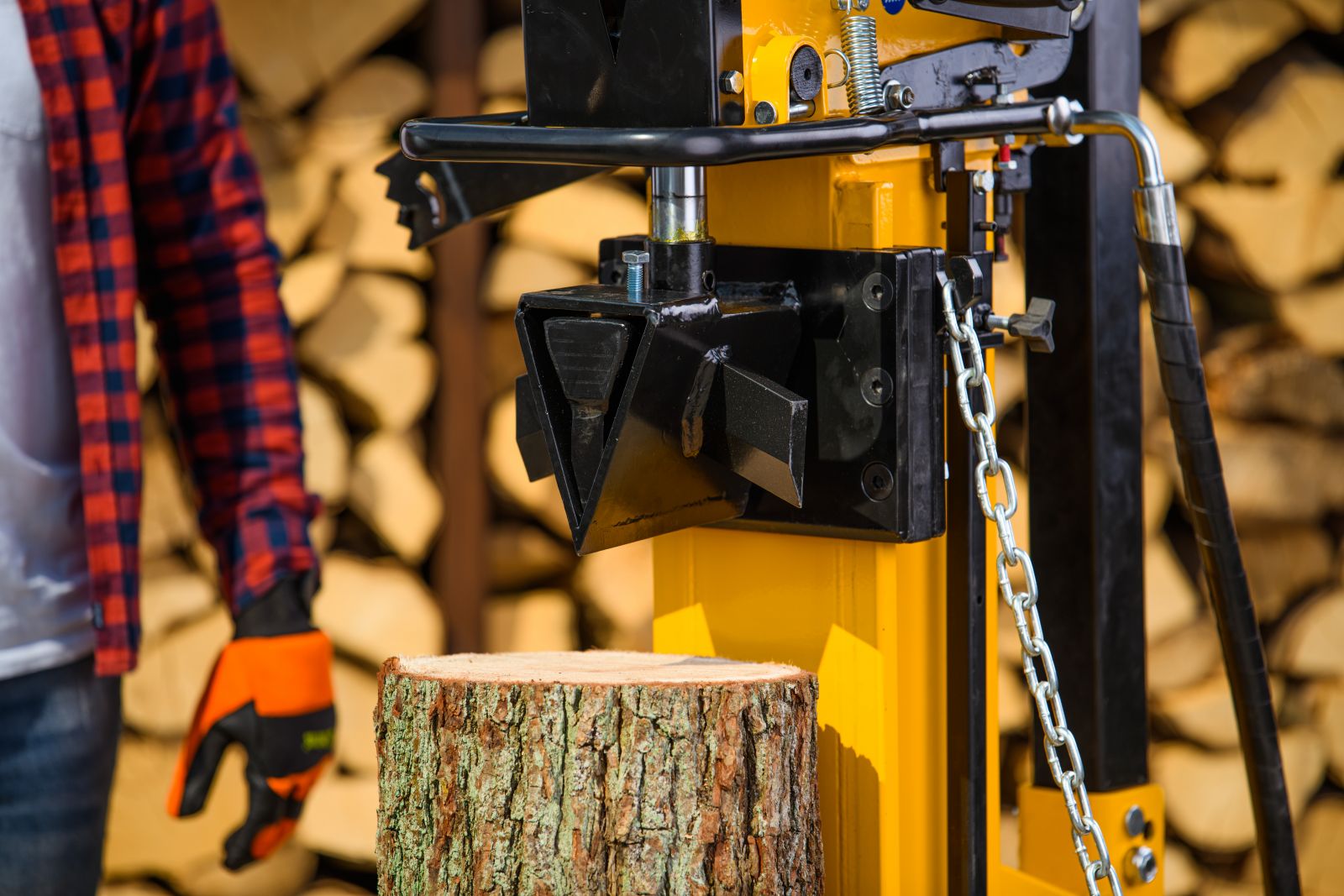
Hydraulic Log Splitters – Types of Machines and the Optimal Log Diameter for Each?
You're standing in front of a pile of wood, wondering which log splitter will handle your logs?This is the most common question asked by homeowners with fireplaces, gardeners, and farmers.The answer isn't complicated—you just need to know the diameter of your logs and the hardness of the wood, and the rest is simply a matter of choosing the right equipment.
Choosing a hydraulic log splitter comes down to two things: the diameter of the logs and the hardness of the wood.The larger the diameter and the harder the wood, the greater the pressure (in metric tons) required.In this article, you'll find a detailed ranking of 6 models from the EWIMAX lineup, categorized by log diameter, as well as a practical comparison of log splitter types—horizontal, vertical, and gas-powered.You'll find out whether a model priced at 1,139 zł will be enough for you, or if you need a professional machine priced at 7,219 zł.
Hydraulic Log Splitters – Where to Start When Choosing One?
Hydraulic Log Splitter is a device that uses a hydraulic cylinder to split logs into smaller pieces.This is the most popular type on the market—hydraulic log splitters account for about 38% of the entire segment.No wonder, since they combine effectiveness, safety, and a relatively low price.
Choosing a specific model comes down to three main criteria:
- Log diameter – this is the most important parameter.It determines how much pressure you need.
- Wood Hardness – Pine and spruce are in a completely different league than oak, hornbeam, or beech.Harder wood requires more force for the same diameter.
- Power Requirements – Most homes have 230V, but for more powerful models, you’ll need 400V.If you don't have access to electricity, a gas-powered log splitter is the solution.
Later in this article, we’ll show you the different types of log splitters, a selection chart based on log diameter, and then a specific ranking of models from the EWIMAX lineup.Let's start with the types of devices.
Types of hydraulic wood splitters – horizontal, vertical, and gas-powered
Each type of hydraulic log splitter has its own strengths and performs well under different conditions.Below are the three main types offered by EWIMAX.
Horizontal log splitters – lightweight, portable, for smaller diameters
Horizontal log splitters are the simplest and least expensive type.Place the log horizontally on the workbench, and the actuator pushes it onto the stationary wedge.Simple, effective, and inexpensive.
Who is it for: Home users who split wood occasionally and whose logs have a diameter of up to about 25 cm.Perfect for pine, spruce, and birch.
Advantages:
- Low price – models start at around 1,100 zł
- Lightweight—about 45 kg—you can easily fit it in the trunk
- 230V power supply – plug it into a standard outlet
- Easy to carry and store
Suitability requirements: If you have logs over 25 cm in diameter or harder wood (oak, hornbeam), a horizontal log splitter may not be powerful enough.You also have to lift the logs onto the workbench, which can be tiring when dealing with larger pieces.
An example from the EWIMAX product line: CEDRUS LS02H – 7 metric tons of pressure, 230V, max diameter 25 cm, price 1,139 PLN.The most popular model in the home segment.
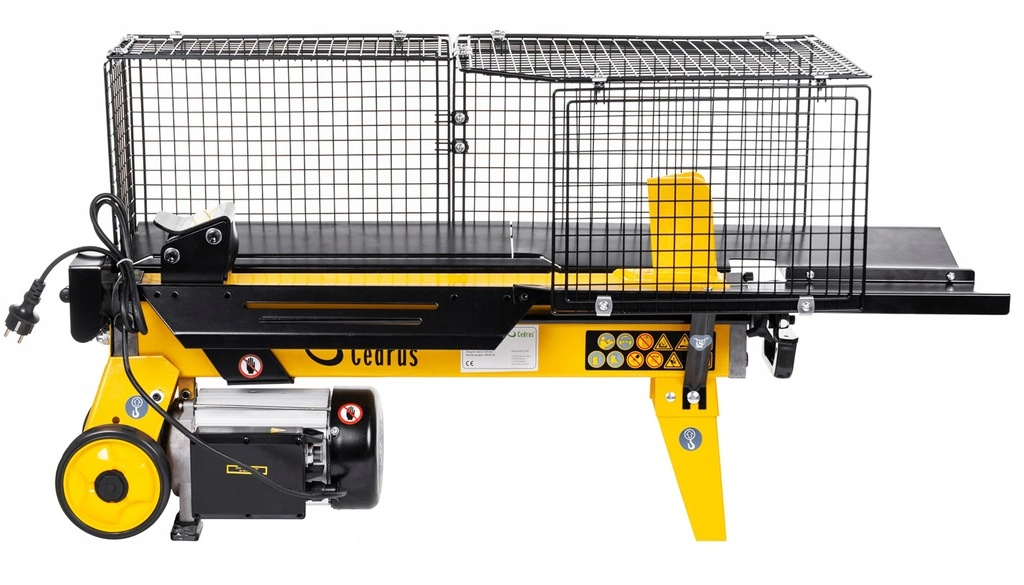 CEDRUS LS02H – 7-metric-ton horizontal log splitter Lightweight, horizontal 230V hydraulic log splitter for logs up to 25 cm in diameter and 52 cm in length—perfect for firewood. 1,139 PLN • View product → |
Vertical log splitters – for larger diameters and longer logs
In vertical log splitters, you place the log vertically on the base, and the cylinder applies pressure from above.This allows you to split longer and heavier pieces without having to lift them onto the table.
Who is it for: Users with logs 25–40+ cm in diameter who split wood regularly and often deal with harder wood.
Advantages:
- Greater pressure force – from 7 to 22 metric tons
- Capable of handling longer logs—up to 110 cm
- Log lifter in higher-end models—no need to lift
- Greater efficiency during regular operation
Selection Criteria: Vertical log splitters are heavier (100–300 kg) and take up more space.Some models require a 400V power supply, which means you'll need the appropriate electrical setup in your garage or workshop.
Examples from the EWIMAX product lineup:
- CEDRUS LS06V – 7 metric tons, 230V, max diameter 30 cm, 1,899 PLN
- CEDRUS LS08V – 11 metric tons, 230V, max diameter 30 cm, 3,514 PLN
- CEDRUS LS09V – 14 metric tons, 400V, max diameter 30 cm, 3,799 PLN
- CEDRUS LS10V – 22 metric tons, 400V, max. length 110 cm, 7,219 PLN
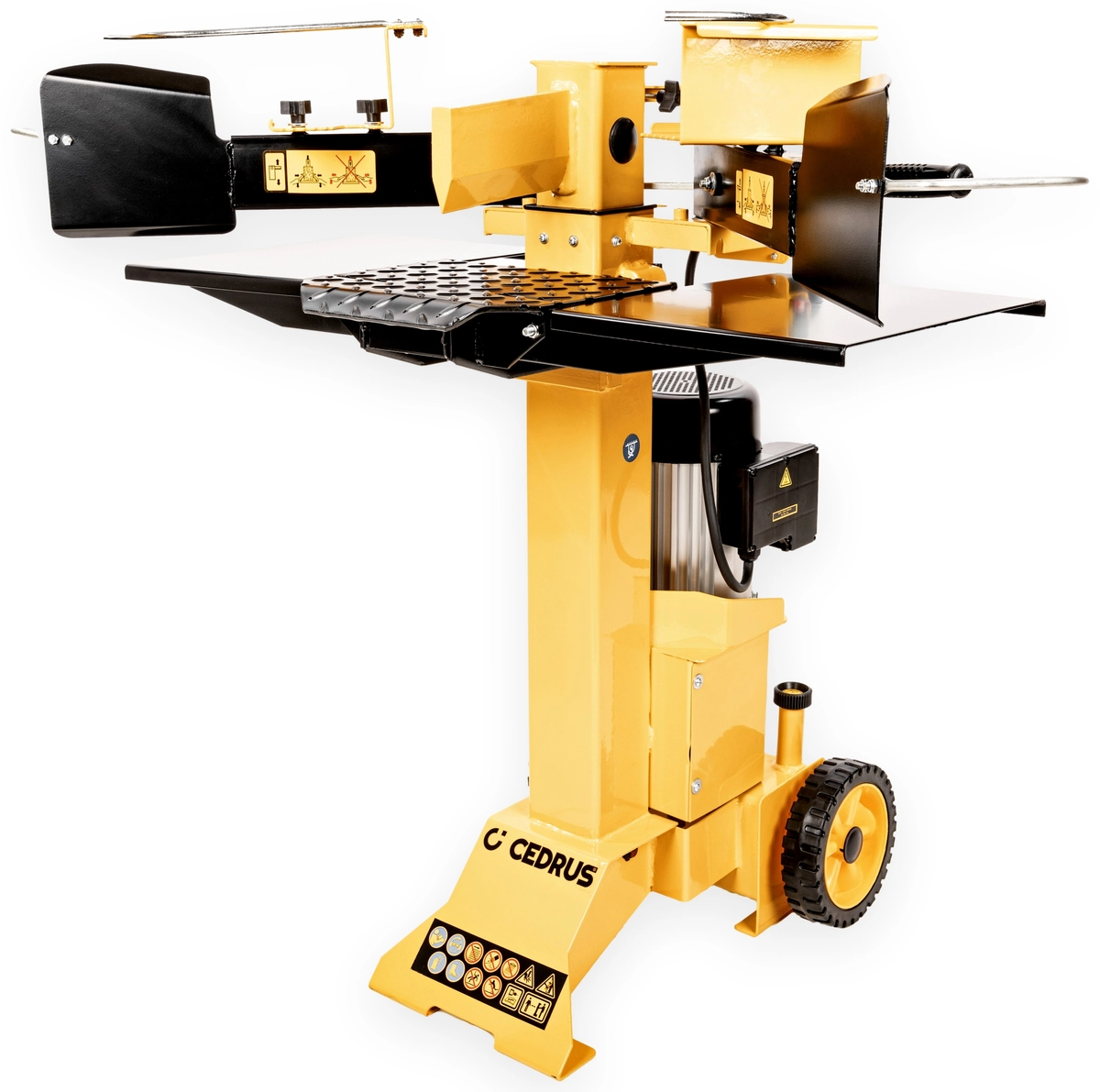 CEDRUS LS06V – 7-metric-ton vertical log splitter 230V vertical hydraulic log splitter with 7 metric tons of splitting force, for logs up to 30 cm in diameter and 55 cm in length – proven in home use. 1,899 PLN • View product → |
Gas-powered log splitters – for use in areas without electricity
Gas-powered log splitters are standalone machines with their own engines.You don't need an outlet—just fill up the tank and you're good to go.
Who is it for: People working in the forest or on plots of land without access to the power grid, farmers, and service companies.
Advantages:
- Complete mobility—you work wherever the wood is
- Pressure force of 12–15 metric tons—they can handle large, knotty logs
- Independence from the power grid
Pros: They are noisier than electric vehicles, require fuel, and need regular maintenance of the internal combustion engine.This is the choice for people who really need mobility.
Examples from the EWIMAX product line:CEDRUS LS12HP-B (12 metric tons, Briggs & Stratton engine) and MASTERCUT LS15TG (15 metric tons, 7 KM).
EWIMAX offers only hydraulic log splitters—that’s our specialty.We don't sell kinetic or drill-type log splitters because we rely on proven hydraulic solutions.
Log Diameter vs. Pressure Force – Log Splitter Selection Table
Pressure (measured in metric tons) is the most important parameter of a log splitter.It's the machine that determines whether it can handle your wood.And the force required depends on two factors: the diameter of the log and the hardness of the wood.
Softwood (pine, spruce, poplar) splits more easily.Hardwood (oak, hornbeam, beech) requires up to twice as much force for the same diameter.The table below shows approximate values—keep in mind that stumps with knots and burls may require more force than indicated.
| Diameter of the log | Softwood (pine, spruce) | Hardwood (oak, hornbeam, beech) | Recommended type | Example EWIMAX Model |
|---|---|---|---|---|
| up to 25 cm | 4–7 metric tons | 7–8 metric tons | horizontal / vertical 230V | CEDRUS LS02H (7T) |
| 25–30 cm | 7–8 metric tons | 8–11 metric tons | vertical 230V | CEDRUS LS06V (7T), LS08V (11T) |
| 30–40 cm | 8–11 metric tons | 11–15 metric tons | vertical 230V/400V | CEDRUS LS08V (11T), MASTERCUT LS15TE (15T) |
| 40 cm+ / carp | 11–15 metric tons | 15–22 metric tons | vertical 400V / gas-powered | CEDRUS LS09V (14T), LS10V (22T) |
These are approximate values.If you have very knotty wood or stumps with roots, always go for a model one level higher.It's better to have some extra power than to struggle with a machine that's too weak.
Ranking of Hydraulic Log Splitters by Log Diameter – Top 6 EWIMAX Models
Below you'll find 6 models from the EWIMAX lineup, listed in ascending order by the diameter of logs they can handle.We describe each model using the same outline: who it's for, specifications, why it's worth considering, and what to look for.
#1 CEDRUS LS02H – the best choice for logs up to 25 cm
Who is this for: Homeowners with a fireplace who mainly split pine, spruce, and birch.Perfect for getting started with a hydraulic log splitter.
Key specifications: Pressure force: 7 metric tons, power supply: 230V, max. diameter: 25 cm, max. length: 52 cm, weight: 45 kg, price: 1,139 PLN.
Why this model: The best value for money in the under-25-cm segment.Lightweight, portable—just plug it into a standard outlet and you're good to go.This is the most popular log splitter in the EWIMAX lineup—and for good reason, since it’s more than enough for most home users.
What to look for: If you mainly have oak logs with a diameter of 25 cm, consider the more powerful Model #2.When cutting hard wood near the diameter limit, it's better to have some power to spare.
#2 CEDRUS LS06V – vertical log splitter for logs up to 30 cm
Who is it for: For users who need a larger diameter and the convenience of vertical splitting.You place the plates on the tray; you don't have to lift them onto the table.
Key specifications: Pressure force: 7 metric tons, power supply: 230V, max. diameter: 30 cm, max. length: 55 cm, weight: 99 kg, price: 1,899 PLN.
Why this model: It combines an affordable price with the convenience of vertical operation.It handles softwood logs up to 30 cm in length with ease.It's a natural step up from the horizontal model.
What to look for: With harder woods (oak, hornbeam) that are nearly 30 cm in diameter, a force of 7 metric tons may be at the limit.In that case, it's better to pay a little extra for Model #3.
#3 CEDRUS LS08V – more power at 230V
Who is it for: People who split harder woods (oak, hornbeam, beech) with a diameter of up to 30 cm but do not have access to 400V power.
Key specifications: Pressure force: 11 metric tons, power supply: 230V, max. diameter: 30 cm, max. length: 104 cm, weight: 178 kg, price: 3,514 PLN.
Why this model: 11 metric tons of pressure at 230V is a rarity.It provides plenty of power for hard wood, yet runs off a standard outlet.It also accommodates logs up to 104 cm long—great for longer pieces.
What to look for: Weight: 178 kg—this is a machine you’ll want to install permanently in one place.You can't fit her in the trunk.
#4 MASTERCUT LS15TE – universal, vertical-horizontal, 15 metric tons
Who is it for: For demanding users who want high force (15 metric tons) with a 230V power supply and the ability to operate in two positions.
Key specifications: Pressure force: 15 metric tons, power supply: 230V, max diameter: 32 cm, max length: 50 cm, weight: 116 kg, price: 4,398 PLN.
Why this model: It works in both vertical and horizontal positions—you choose whichever is more convenient.15 metric tons at 230V is a lot—it can even handle hard wood with a larger diameter.
What to look for: Shorter maximum log length (50 cm) than in purely vertical models.If you mainly split long logs, check out models #5 or #6.
#5 CEDRUS LS09V – high performance at 400V
Who is this for: For farms and workshops with access to a 400V electrical system.Professional performance at an affordable price.
Key specifications: Pressure force: 14 metric tons, power supply: 400V, max diameter: 30 cm, max length: 104 cm, weight: 187 kg, price: 3,799 PLN.
Why this model: Best price-to-thrust ratio in the 400V segment.Equipped with a log lifter, which—at 187 kg—makes a huge difference in working comfort.
What to look for: Requires a 400V (high-voltage) installation.If you only have 230V, choose model #3 or #4.
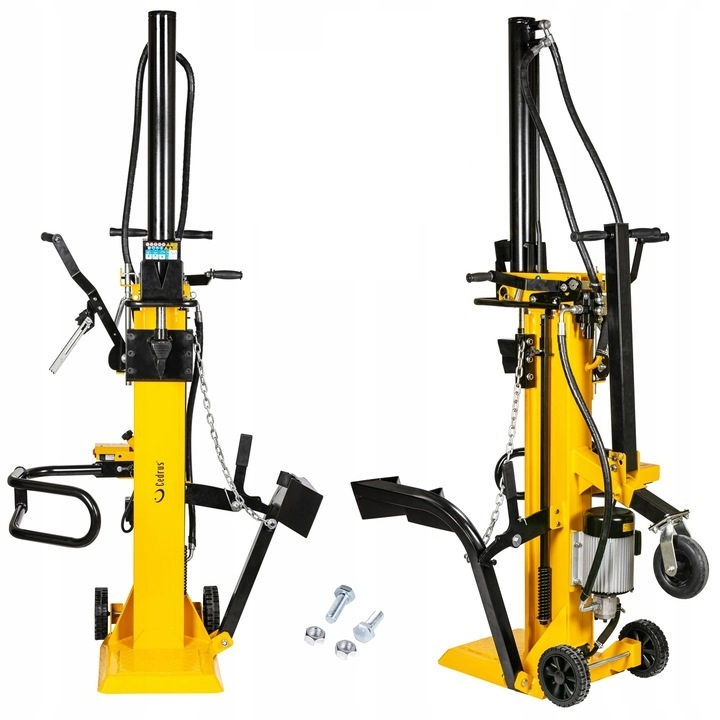 CEDRUS LS09V – 14-metric-ton vertical log splitter Professional, three-phase, 400V hydraulic log splitter with 14 metric tons of splitting force, for logs up to 30 cm in diameter and 56–104 cm in length—with a log lift. 3,799 PLN • View product → |
#6 CEDRUS LS10V – professional, 22 metric tons
Who is it for: Professionals, service companies, and farmers who cut the largest-diameter, knotty stumps and stump stubs.
Key specifications: Pressure force: 22 metric tons, power supply: 400V, max. length: 110 cm, weight: 308 kg, price: 7,219 PLN.
Why this model: The most powerful log splitter in the EWIMAX lineup.22 metric tons of pressure can handle any type of wood—oak logs, knotty stumps, and logs 40 cm in diameter or larger.With a log lifter and a working length of 110 cm, this machine is designed for heavy-duty, everyday work.
What to look for: Weighing 308 kg and powered by 400V—this is an investment for professionals.It would be overkill for occasional use at home.
Comparison Table of All Models
| Model | Type | The force of pressure | Power supply | Maximum diameter | Max length | Weight | Price |
|---|---|---|---|---|---|---|---|
| CEDRUS LS02H | horizontal | 7T | 230V | 25 cm | 52 cm | 45 kg | 1,139 PLN |
| CEDRUS LS06V | vertical | 7T | 230V | 30 cm | 55 cm | 99 kg | pLN 1,899 |
| CEDRUS LS08V | vertical | 11T | 230V | 30 cm | 104 cm | 178 kg | 3,514 PLN |
| MASTERCUT LS15TE | vertical-horizontal | 15T | 230V | 32 cm | 50 cm | 116 kg | 4,398 PLN |
| CEDRUS LS09V | vertical | 14T | 400V | 30 cm | 104 cm | 187 kg | pLN 3,799 |
| CEDRUS LS10V | vertical | 22T | 400V | b.d. | 110 cm | 308 kg | 7,219 PLN |
How to Choose the Right Log Splitter for You – A Practical Decision-Making Guide
Instead of giving you step-by-step instructions, ask yourself three simple questions.Your answers will guide you to the right model.
1.What is the diameter of your logs??
That's the most important question.Check out a few of the thickest logs in your stack—they’re the ones that will determine your choice.If most of them are up to 25 cm, a horizontal model will suffice.If there are thicker ones (25–40 cm), you'll need a vertical.For sizes over 40 cm, go for the most powerful models.
2.What kind of wood do you mainly split??
Pine and spruce are softwoods—even a less powerful log splitter can handle them.Oak, hornbeam, and beech are hardwoods—you'll need to apply more pressure.For hardwood, always add one power level to the value calculated based on the diameter.
3.What kind of power source do you have access to??
- 230V (standard outlet) – you can choose from models up to 15 metric tons.For 80% of home users, that's more than enough.
- 400V (power) – unlocks access to the most powerful upright models.
- No power? Choose a gas-powered log splitter.
For 80% of home users, the best choice is a 7-metric-ton horizontal log splitter (such as the CEDRUS LS02H) or a 7–11-metric-ton vertical log splitter running on 230V (such as the CEDRUS LS06V or LS08V).Only if you regularly cut large-diameter hardwood should you consider models in the 14–22-metric-ton range.
And if something happens?EWIMAX offers a door-to-door service: – you secure the log splitter to a pallet, the courier picks it up, the manufacturer repairs it, and sends it back.You don't have to go anywhere.
Safety and the EN 609 Standard—What You Need to Know
All hydraulic log splitters in the EWIMAX product line comply with the EN 609 standard, which is mandatory in the European Union.What this means in practice?Two-hand operation system – you must use both hands to activate the actuator, which eliminates the risk of your hand entering the work area.In addition, safety guards for the splitting area.
Basic health and safety rules for working with a log splitter:
- Always wear safety glasses—wood splinters can fly off unexpectedly
- Use work gloves with a non-slip coating
- Wear shoes with steel-toed caps—a falling log weighs several dozen kilograms
- Place the log splitter on a stable, level surface
- Do not split logs while holding them in your hands—use a workbench or a stand instead
- Don't work when you're tired—it's easy to make mistakes when you're tired
When it comes to maintenance, don't forget the hydraulic oil.The log splitters in the EWIMAX lineup use HL46 or HV46 oil.An oil change is recommended every 150 hours of operation—which is roughly once per season with regular use.
FAQ - the most common questions
Which wood splitter should I choose—230V or 400V??
For most homes, 230V is sufficient.230V models (such as the CEDRUS LS02H, LS06V, LS08V, or MASTERCUT LS15TE) offer a cutting force ranging from 7 to 15 metric tons—which is more than enough for logs up to 30–32 cm in diameter.400V is only necessary for professional use and the largest diameters.
How many metric tons should an oak log splitter weigh??
Oak is a hardwood.For a diameter of up to 25 cm, you'll need 7–8 metric tons.For fish measuring 25–30 cm, aim for 8–11 metric tons.Over 30 cm – at least 11–15 metric tons.It's better to choose a model with plenty of power, because knotty oak logs can be surprisingly tough.
Vertical or Horizontal Log Splitter—Which One Should You Choose??
The horizontal model is cheaper, lighter, and portable—good for logs up to 25 cm and occasional use.The vertical model is more expensive and heavier, but it can handle larger diameters and longer logs, and you don't have to lift the wood onto the table.If you have the space and use it regularly, choose a vertical one.
Recommended
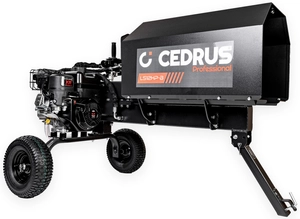
Cedrus LS12HP-B HYDRAULIC HYDRAULIC HYDRAULIC HORIZONTAL LUMBER SHELVING COMPACTOR 12 TONS B&S Briggs & Stratton XR950 Series Cedrus Professional CEDLS12HP-B - OFFICIAL DISTRIBUTOR - AUTHORIZED DEALER CEDRUS

CEDRUS LS02H HORIZONTAL HYDRAULIC WOOD SPLITTER 7 TON CEDRUS LS02 CEDLS02H - EWIMAX - OFFICIAL DISTRIBUTOR - AUTHORIZED CEDRUS DEALER
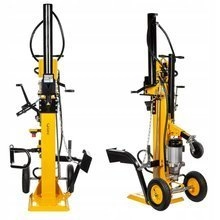
CEDRUS LS10 HYDRAULIC ELECTRIC WOOD SPLITTER CEDRUS CEDLS10V VERTICAL CHIPPER PRESSURE 22 TONS - EWIMAX - OFFICIAL DISTRIBUTOR - AUTHORIZED CEDRUS DEALER
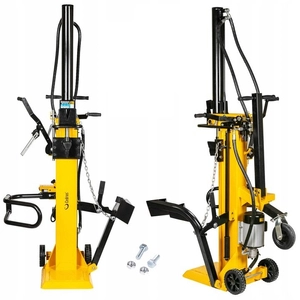
CEDRUS LS09 HYDRAULIC ELECTRIC WOOD SPLITTER CEDRUS LS09V VERTICAL CHIPPER PRESSURE 14 TONS CEDLS09V - EWIMAX - OFFICIAL DISTRIBUTOR - AUTHORIZED CEDRUS DEALER

CEDRUS LS08 HYDRAULIC ELECTRIC WOOD SPLITTER CEDRUS LS08V VERTICAL CHIPPER PRESSURE 11 TONS CEDLS08V - EWIMAX - OFFICIAL DISTRIBUTOR - AUTHORIZED CEDRUS DEALER

CEDRUS LS06 HYDRAULIC ELECTRIC WOOD SPLITTER CEDRUS LS06V VERTICAL CHIPPER PRESSURE 7 TON CEDLS06V - EWIMAX - OFFICIAL DISTRIBUTOR - AUTHORIZED CEDRUS DEALER
