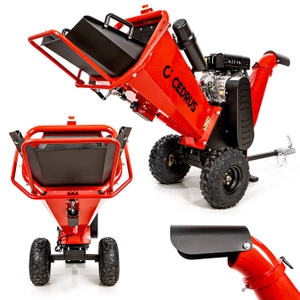
Drum-type or disc-type wood chipper? Design Differences and Performance
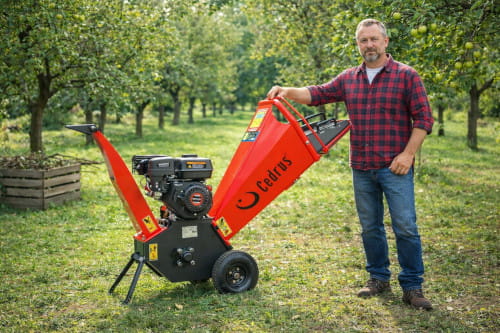
Choosing the right branch shredder is one of the most important decisions a garden, orchard, or wooded area owner faces.Most often, it boils down to one question: drum-type wood chipper vs. disc-type wood chipper—which design will perform better in everyday use??Although both machines serve the same purpose—shredding branches into wood chips—the differences between a drum chipper and a disc chipper are much greater than they might seem at first glance.
A different cutting mechanism, a different method of feeding material, and different operating characteristics mean that each of these types of wood chippers meets different user needs.An improperly designed machine can result in frequent branch jams, low performance, or wood chips that do not meet expectations.
In this article, we compare drum-type and disc-type wood chippers, analyzing their design, performance, and practical applications so that you can clearly assess which wood chipper to choose in 2026 for your specific working conditions.
Table of Contents:
- What Is a Drum Chipper and How Does It Work??
- What Is a Disc Chipper and How Does It Work??
- Advantages and Disadvantages of Drum Wood Chippers
- Advantages and Disadvantages of Disc Wood Chippers
- Drum-Type Wood Chipper vs. Disc-Type Wood Chipper – Key Design Differences
- Which one offers better performance and efficiency??A Practical Comparison
- Applications – When Is a Drum Chipper Better, and When Is a Disc Chipper Better??
- Drum-type or disc-type wood chipper?Which one is better for your needs??
What Is a Drum Chipper and How Does It Work??
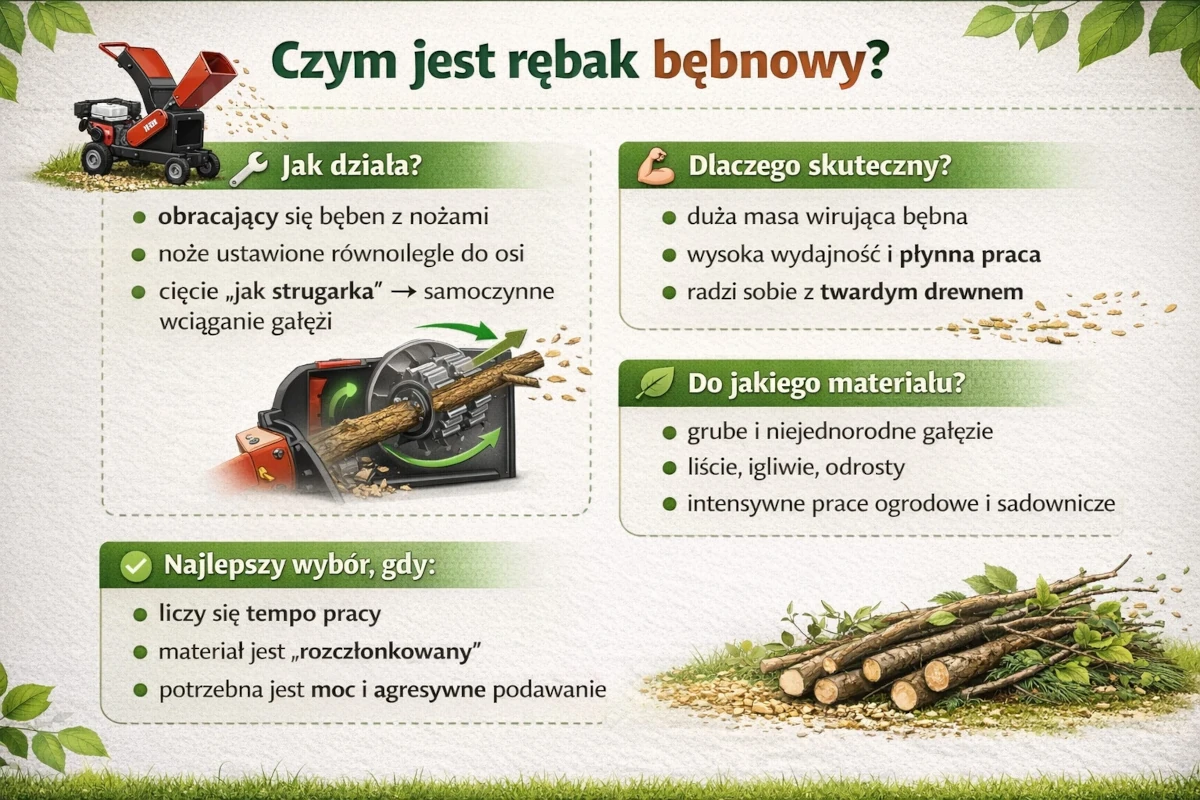
Drum chippers are currently among the most popular machines on the market, especially in the segment of high-powered internal-combustion engines.Their design is associated with durability and the ability to “handle” large volumes of material.
Design and Operating Principles of Drum Wood Chippers
At the heart of this machine is a rotating drum (cylinder) on which the cutting blades (usually two or more) are mounted.These blades are positioned parallel to the drum's axis of rotation.During operation, the drum rotates at high speed, and the blades strike the feedstock, tearing off pieces of wood one after another.A distinctive feature of this design is that the cutting mechanism works somewhat like a planer—the blades cut into the branch at an angle, which generates a natural pulling force. This means the operator doesn't have to force the branches in; the machine often "pulls" the material in on its own.
Typical Applications for Drum-Type Wood Chippers
Drum chippers are excellent at processing heterogeneous material.They are ideal for shredding branches with a lot of leaves, pine needles, and small shoots. Thanks to the drum's high rotating mass, these wood chippers also handle harder types of wood with ease.They are commonly used in gardens, where tree trimmings are “scattered” and require a powerful feeding mechanism.
What Is a Disc Chipper and How Does It Work??
A disc chipper is a classic design that has been valued for decades for its precision and efficiency, especially when processing clean wood.
Design and Operating Principles of Disc Wood Chippers
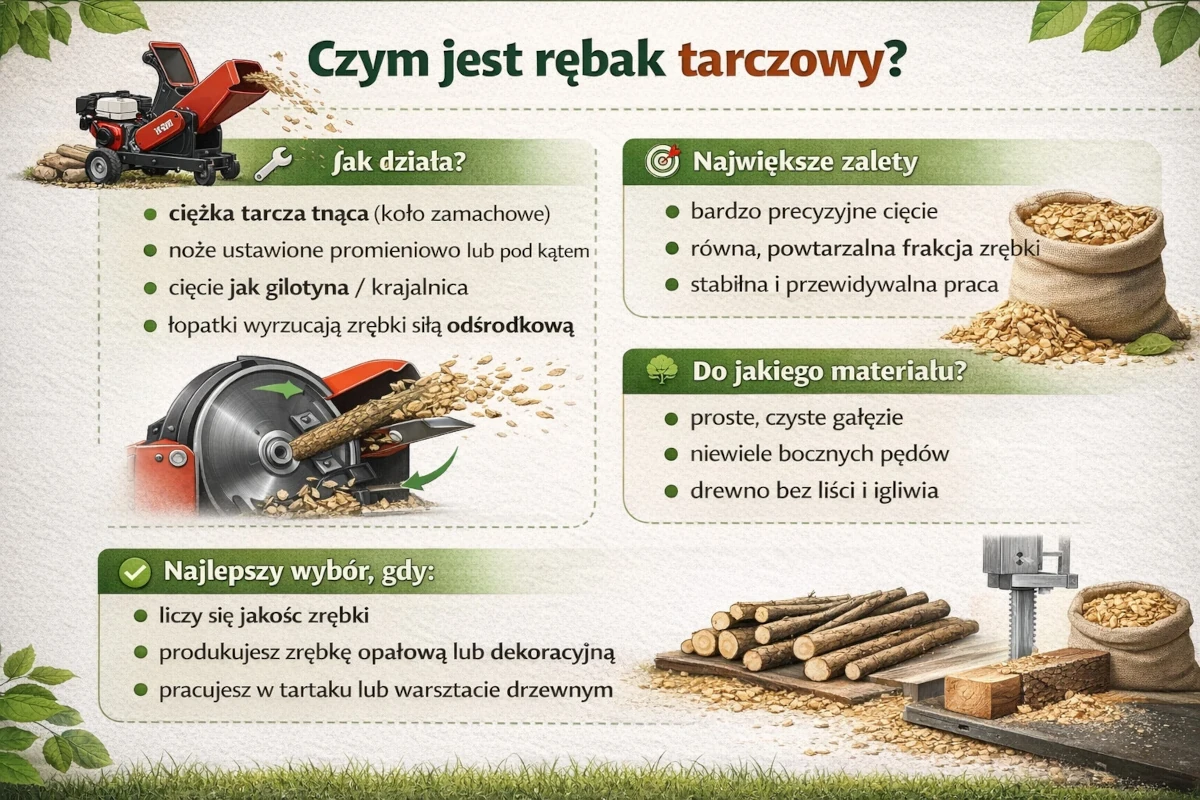
In this case, the cutting mechanism consists of a heavy steel disc (flywheel) with blades mounted on its surface.The blades are arranged radially or at a slight angle relative to the center of the disc.As the disc rotates, the branches are fed at a right angle or an acute angle to the blades.It works like a guillotine or a vegetable slicer. The disc often has additional blades that act as an ejector, pushing the wood chips out through the discharge chute using centrifugal force and air momentum.
Typical Applications for Disc Wood Chippers
Disc chippers are indispensable when high-quality wood chips with a consistent shape are required.They are preferred by people who mainly shred straight branches without many side shoots. They are very commonly found in sawmills and in the production of decorative or fuel wood chips, where aesthetics and particle size are important.
Advantages and Disadvantages of Drum Wood Chippers
Understanding the strengths and weaknesses of each design is the key to being satisfied with your purchase.Drum-type vs. disc-type wood chippers: a clash of two different operating philosophies.
Key Strengths
The main advantages of a drum chipper include:
- Suction force.The drum mechanism has a natural tendency to pull in branches, which significantly reduces the operator's workload.
- Compactness.Drum chippers are often narrower and more maneuverable than their disc-type counterparts with similar power ratings.
- Versatility.They handle green, wet, and very sprawling material very well.
- Lower sensitivity to contaminants.The drum's design is generally more resistant to minor contamination from dirt or sand.
Design Limitations
When discussing the drawbacks of a drum chipper, we must mention:
- Vibrations.The drum's operation typically generates greater vibrations that are transmitted to the housing.
- Non-uniform wood chips.The feedstock can consist of irregular pieces, ranging from small splinters to larger pieces"slices".
- Noise.These machines are often noisier due to the impact of the blades against the wood.
Advantages and Disadvantages of Disc Wood Chippers
Disc chippers have unique features that make them unrivaled under certain conditions.
Key Strengths
The advantages of a disc wood chipper include:
- Cutting Precision.They produce very clean and uniform wood chips, ideal for mulching flower beds.
- Energy Efficiency.The blade acts like a flywheel—once it’s up to speed, it requires less energy to maintain its motion, which helps save fuel or electricity when cutting straight pieces of wood.
- A perfect throw.The blade system on the disc can eject wood chips over a long distance, which makes it easier to load them onto a trailer.
Design Limitations
The main disadvantages of a disc chipper are:
- Weaker suction.Without a hydraulic feed roller, the operator must push the branches harder against the disc.
- Susceptibility to coccidiosis.Thin, limp twigs may “slide” across the blade or wrap around the shaft instead of being cut.
- Dimensions.The blade requires a wide housing, which makes the machine wider and sometimes more difficult to transport through narrow gates.
Drum-Type Wood Chipper vs. Disc-Type Wood Chipper – Key Design Differences
To fully understand the differences between a drum chipper and a disc chipper, it is necessary to examine the technical details.
Material grinding mechanism
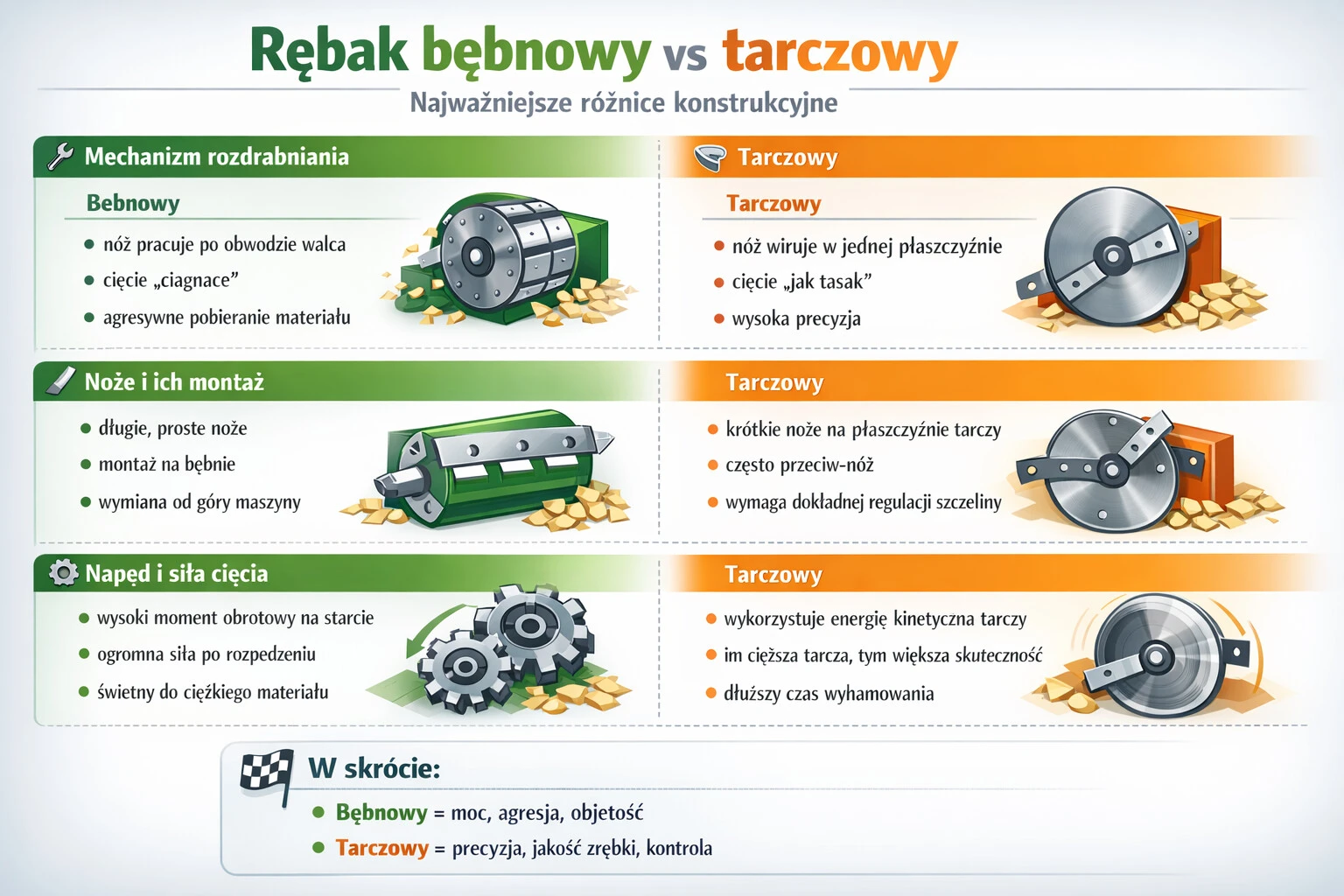
In a drum chipper, the branch is “cut off” by a blade that moves around the circumference of the drum.In a disc chipper, the blade rotates in a single plane, acting like a spinning cleaver.This difference makes the drum mechanism more aggressive and the disc mechanism more precise.
Blade Design and Assembly
In drum models, the blades are usually long and straight, attached to a sturdy drum body.Replacing the drum blades usually requires access from the top of the machine.In disc chippers, the blades are shorter and are bolted to the disc surface.Disc chippers often feature a so-called "counter-blade," which allows for an even more precise cut but requires careful adjustment of the gap..
Drive and Cutting Force
Drum-type wood chippers often require higher starting torque to get the heavy drum moving.However, once they pick up speed, their penetrating power is immense.Disc chippers rely on the kinetic energy stored in the disc—the heavier the disc, the better it handles thick branches, but it also takes longer to bring it to a stop.
Which one offers better performance and efficiency??A Practical Comparison
Performance is a factor that every buyer cares about.How do these designs perform in everyday use??
Maximum branch diameter
For the same engine power (e.g., 6.5 KM or 15 KM), drum wood chippers typically have a slightly larger maximum cutting diameter.This is because the drum knives cut into the material gradually.If a branch is too thick, a disc chipper may suddenly lose speed if the disc isn't heavy enough.
Operating speed and grinding rate
If you have piles of sprawling branches to process, a drum-type wood chipper will outperform others in terms of speed thanks to its superior feed capacity.However, if you have perfectly prepared, straight logs, a disc-type wood splitter can cut them faster and more cleanly.
Wood chip quality and type of feedstock
- Drum-type.The wood chips are "shredded," making them ideal as biomass, for composting, or as technical mulch.
- Disc-type.Wood chips come in the form of uniform flakes (chips) and are perfect as a decorative element in the garden or for a smokehouse (when made from the right type of wood).
Applications – When Is a Drum Chipper Better, and When Is a Disc Chipper Better??
In practice, choosing the right design depends not only on technical specifications, but above all on actual operating conditions and the type of material that will be processed most frequently.It is the intended use that determines which wood chipper to choose to ensure that the work is fast, safe, and frustration-free.A homeowner tending a backyard garden has different needs than an orchardist processing hundreds of branches, and yet different needs than someone working in rough terrain with thick, hard wood.Below, we discuss the applications in which a drum-type wood chipper performs better, and when a disc-type design has the advantage.
Work in the Home Garden
Most home users choose gasoline-powered wood chippers with a drum design.They are more resistant to operator error and handle the mixed material—which is typically left over after pruning hedges, ornamental shrubs, and fruit trees—more effectively.Among the greatest advantages of a drum-type wood chipper in a home garden are its powerful automatic feed and its ability to shred branches with leaves and small shoots.
It’s worth keeping in mind, however, that the drawbacks of a drum-type wood chipper for home use include slightly noisier operation and less uniform wood chips, which may be important if the material is to serve a decorative purpose.
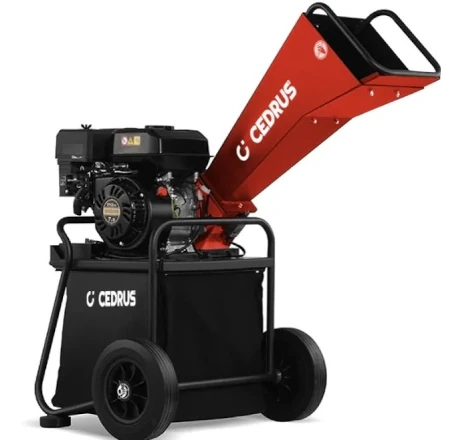
Cedrus RB01C 5 cm Gas-Powered Branch Shredder
Orchard, plot of land, large quantities of branches
In orchards where the branches are often straight, long, and free of side shoots, disc chippers can be very effective—especially tractor-mounted (PTO) models.Their major strengths are the uniform particle size of the wood chips and the long material ejection distance, which are among the key advantages of a disc chipper when operating on a larger scale.
On the other hand, the disadvantages of a disc chipper become apparent when processing more branched material—thin branches may slip off the disc, and the lack of strong pull requires greater operator involvement.That is why modern, powerful gasoline-powered drum wood chippers are increasingly replacing older disc-type models, offering greater comfort and less fatigue during long hours of work.
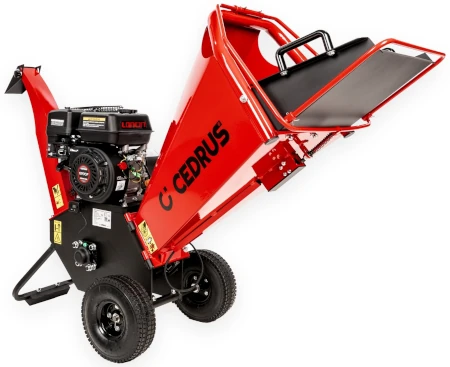
Cedrus RB02 10-cm Gas-Powered Wood Chipper
Thicker branches and challenging working conditions
For thicknesses exceeding 10–12 cm, massive drum mechanisms are by far the most common.Their weight, inertia, and aggressive cutting action are key to reliably chipping hard, knotty wood without the risk of jamming.Under such conditions, the advantages of a drum chipper—high torque and stable operation—cannot be overstated.
Disc chippers are less common in this application category because the drawbacks of disc chippers when processing very thick material include a higher risk of a drop in rotational speed and the need for precise feeding of branches.That is why, for work in difficult terrain, during logging operations, and when clearing large forest plots, the drum-type design remains the most versatile and safe solution.
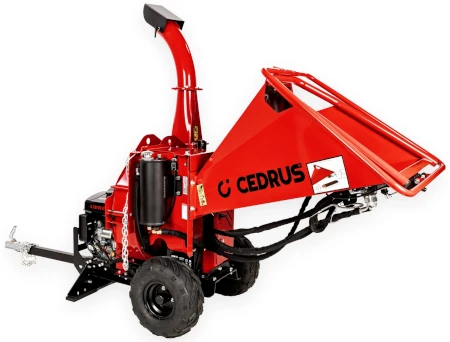
Cedrus RB05 PRO HE 15KM Hydraulic Branch Shredder
Drum-type or disc-type wood chipper?Which one is better for your needs??
To summarize our comparison of drum and disc wood chippers:
Choose a drum chipper if:
- Do you want the machine to feed the branches in on its own?.
- You have a lot of material consisting of leaves, pine needles, and small twigs.
- Are you looking for a compact machine design?.
- The wood chips are intended primarily for disposal or composting.
Choose a disc chipper if:
- Are you looking for perfectly even, decorative wood chips?.
- You mainly chip straight branches that have had their shoots removed.
- Do you need to transport the excavated material a long distance?.
- Do you have PTO-powered machines (though the gasoline-powered versions are great, too)?.
Regardless of the design you choose, be sure to always match the motor's power to the tasks you plan to perform.Ewimax offers both professional branch chippers (drum-type) and precision electric chippers for smaller gardening tasks.
Are you still unsure which design will work best for you??Contact the experts at Ewimax—we’ll be happy to advise you and help you choose a machine that will serve you for years to come!
Recommended

CEDRUS RE04 2800W / 45mm GARDEN ELECTRIC KNIFE SHAKER - OFFICIAL DISTRIBUTOR - AUTHORIZED DEALER CEDRUS
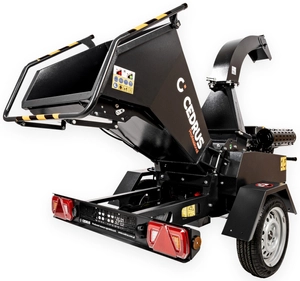
CEDRUS R13 COMBINED REBAK SHredder for communal branches with homologation / 13cm / 24 hp CEDRUS CEDRBR13 RBR13 JONCO R13A/A - EWIMAX - OFFICIAL DISTRIBUTOR - AUTHORIZED DEALER CEDRUS