
Which Generator Should You Choose for Your Home and Garden?? Comparison of CEDRUS, Oleo-Mac, and LONCIN Models – A Buying Guide
We are hearing more and more about threats to the stability of the power grid—attacks on critical infrastructure, extreme weather events, and system overloads mean that a blackout is no longer just a scenario straight out of a disaster movie, but has become a real risk.The Polish market for power generators is experiencing rapid growth in 2026, with sales driven not only by the fear of darkness but, above all, by the need to protect sensitive equipment—such as heat pumps, central heating boilers, alarm systems, and submersible pumps.
Whether you're looking for a backup in case of a power outage or need power on your property to run your garden tools, choosing the right generator is a decision that will last for years.We'll help you make an informed decision by comparing three leading brands available in Poland: CEDRUS, Oleo-Mac, and LONCIN.
TL;DR The generator's power output should be 30–50% higher than the total power of the connected devices.For a home with a heat pump, you'll need at least 5–8 kW.A quiet 2–3 kW inverter generator is all you need for your plot and garden.CEDRUS is a Polish brand that offers good value for the price.Oleo-Mac stands for premium Italian quality.LONCIN offers excellent value for money and is a recognized manufacturer of engines.As an authorized customer, you can purchase all three brands at the EWIMAX store.
Which Generator Should You Choose??– Key Parameters
Before we move on to comparing specific models, you need to understand the basic specifications that will determine whether your choice is the right one.A mistake at this stage could result in either damaged equipment or an unnecessarily overpriced purchase.
Standby and startup power—how to calculate them?
This is the most important parameter and, at the same time, the source of the most errors.Every electrical device has two power ratings: rated (continuous, operating) and starting (starting).Electric motors, compressors in heat pumps, and submersible pumps draw as much as 3–4 times more current at startup than during normal operation.
Sample power requirements for popular devices:
| Device | Working power | Starting power |
|---|---|---|
| Fridge | 200 W | up to 700 W |
| Central Heating Boiler / Circulation Pump | 50–300 W | up to 500 W |
| Submersible pump | 750–1,500 W | up to 3,000 W |
| LED lighting | 20–200 W | without a jump |
| Electric mower | 1,000–1,500 W | up to 2,000 W |
| Chainsaw | 1,500–2,500 W | up to 3,500 W |
| Washing Machine | 2200 W | up to 3,000 W |
The golden rule: the total power rating of all the devices you want to run at the same time, multiplied by 1.3–1.5 (a 30–50% margin), plus the highest startup current.If you need to power a refrigerator (700 W startup), a central heating furnace (300 W), and lighting (100 W), the minimum power output of the generator is about 2 kW with a pure sine wave..
Pure vs. Modified Sine Wave – Electronics Safety
This is the second key distinction.Generators with pure sine wave generate electricity with parameters similar to those of the power grid.You can't do without it if you plan to connect modern electronic devices—heat pump controllers, central heating furnaces with sensors, inverter-equipped refrigerators, computers, or TVs.Generators with modified sine wave (cheaper frame-type models) can power heaters, light bulbs, or simple motors, but sensitive electronics may malfunction or be damaged.
In practice: If you're looking for a generator for your home with a modern electrical system, go for a pure sine wave (inverter or frame-type with AVR/IGBT)..
Inverter-type or frame-type (conventional) generator?
This is one of the first decisions you'll have to make.Each technology has its own strengths and ideal applications.
Inverter Generator – Quiet and Safe
How it works: The unit generates alternating current, rectifies it to direct current, and then produces a pure sine wave with stable parameters using an inverter circuit.Advantages?First and foremost, low noise levels (52–72 dB, which is equivalent to a normal conversation), a pure sine wave as standard, lower fuel consumption (the motor adjusts its RPM to the load), and a compact size.
Recommended models for you:
- CEDRUS IN2000R (1.9 kW) – 1,899 PLN.Polish manufacturer, copper generator, ideal for a small plot of land and for basic emergency power.
- Oleo-Mac PZU 30 I (2.5 kW) – 2,849 PLN.Italian precision, quiet, stable sine wave.For the Discerning Customer.
- LONCIN LC3000I (2.3/2.5 kW) – 2,564 PLN.A bestseller in its class, with an excellent power-to-weight ratio.For the garden and trips.
Frame-type generator (classic) – more power for less money
Conventional power generation units with synchronous or asynchronous generators.They are cheaper per kW of power, but they are noisier (75–96 dB), heavier, and produce a modified sine wave—although models equipped with an AVR (automatic voltage regulation) system significantly improve the quality of the power.
When to Choose a Frame?When you need a lot of power to supply your entire home (heat pump, several circuits), and noise isn't an issue (the unit is in the garage or boiler room with proper ventilation).
Recommended models:
- CEDRUS AG5-1F (5.5 kW) – 2,659 PLN.One of the best choices in the under 3,000 zł price range.Copper generator, AVR included as standard.
- Oleo-Mac PZU 65 DCS (5.5 kW) – 4,199 PLN.Professional quality, Loncin engine, ideal for continuous operation.
- LONCIN LC5000-AS (5 kW) – 4,564 PLN.Powerful, stable, with AVR—the epitome of reliability.
Recommendation: For a plot of land or garden, choose a 2–3 kW inverter.A Home with a Heat Pump – 5–8 kW Frame Model with AVR.
Brand Comparison: CEDRUS, Oleo-Mac, LONCIN – Which One Is Right for Whom??
Each of the three brands has a different philosophy and targets a slightly different audience.Below, we'll break them down into their basic components.
CEDRUS – a Polish brand, budget to mid-range
CEDRUS is a Polish manufacturer that has gained immense popularity in recent years.Key advantages: copper alternators (better conductivity and durability than aluminum), AVR system included as standard on frame models, and an affordable price.The brand targets customers who are looking for reliable equipment without overpaying for the brand name.
Models available in the EWIMAX lineup:
- IN1000R (inverter, 1 kW) – OK.1,400–1,500 PLN
- IN2000R (inverter, 1.9 kW) – 1,899 PLN
- AG3-1F (frame-type, 3 kW) – 2,329 PLN
- AG5-1F (frame-type, 5.5 kW) – 2,659 PLN
- AG6E-1F (frame-type, 6 kW) – 2,659 PLN
CEDRUS is a good choice if you're looking for a generator for your home or garden at a reasonable price and want Polish customer service and easy access to replacement parts.
Oleo-Mac – Premium Italian Quality
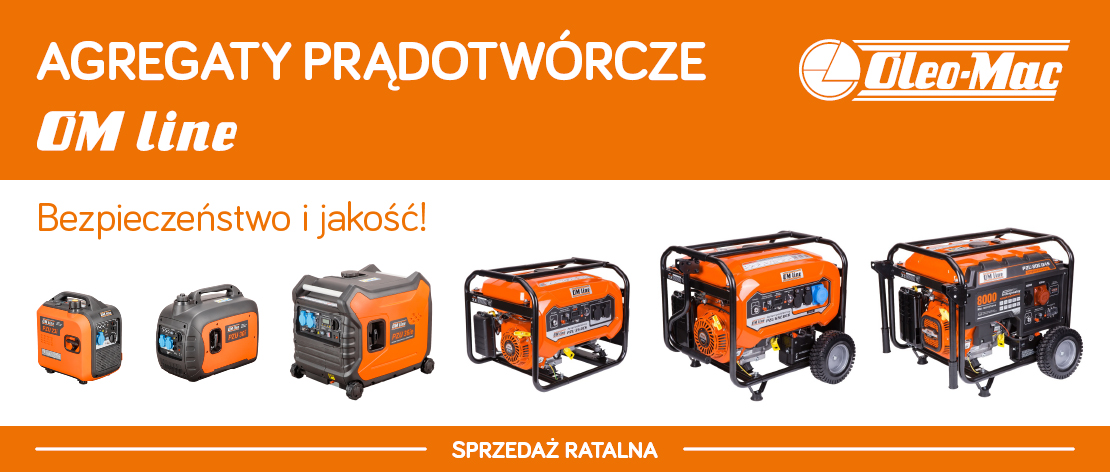
Oleo-Mac is a renowned Italian manufacturer of gardening and power equipment.Generators from this brand stand out for their careful craftsmanship, quiet operation (for their class), durable engines (often Loncin), and modern design.This is the choice for customers who are looking for equipment that will last for years and value reliability.
Available models:
- PZU January 23 (inverter, 2 kW) – 2,516 PLN
- PZU 30 I (inverter, 2.5 kW) – 2,849 PLN
- PZU 36 IE (inverter, 3.3 kW, E-start) – 3,514 PLN
- PZU 35 DCS (frame-mounted, 3.1 kW, AVR) – 1,851 PLN
- PZU 65 DCS (frame-type, 5.5 kW) – 4,199 PLN
- PZU 80E DAS (frame-mounted, 6.5 kW) – 4,265 PLN
Oleo-Mac is the perfect choice when the generator is to be part of a permanent emergency power system in the home, and equipment failure is not an option.
LONCIN – a global leader in engines, offering excellent value for money
LONCIN is a Chinese giant and the world's largest manufacturer of engines for small equipment (m.in.(for Atlas Copco).Their generators set the technological standard in their price range.LONCIN is famous for its incredibly iconic, quiet, and fuel-efficient engines, and its inverter models are on par with equipment from renowned Japanese brands in terms of performance.
Available models:
- LC2000I (inverter, 1.8 kW) – 1,899 PLN
- LC3000I (inverter, 2.3/2.5 kW) – 2,564 PLN
- LC3500i (inverter, 3/3.3 kW, E-start) – 3,899 PLN (bestseller, twin of the Atlas Copco P3500I)
- LC2500-AS (frame-type, 2.2 kW) – 1,139 PLN
- LC3500-AS (frame-type, 3.1 kW) – 2,198 PLN
- LC5000-AS (frame-mounted, 5 kW) – 4,564 PLN
- LC6500D-AS (frame-type, 5.5 kW) – 3,134 PLN
LONCIN is the choice of the discerning customer who recognizes technical value and seeks maximum performance at an optimal price.
Comparison Table of Recommended Models
| Application | CEDRUS | Oleo-Mac | LONCIN |
|---|---|---|---|
| Inverter for the garden/plot (2–3 kW) | IN2000R – 1,899 PLN | PZU 30 I – 2,849 PLN | LC3000I – 2,564 PLN |
| Frame for a home with a heat pump (5–6 kW) | AG5-1F – 2,659 PLN | PZU 65 DCS – 4,199 PLN | LC5000-AS – 4,564 PLN |
| A powerful whole-house heat pump (7–8 kW) | AG6E-1F – 2,659 PLN | PZU 80E DAS – 4,265 PLN | LC6500D-AS – 3,134 PLN |
Home Heating System with a Heat Pump – What Are the Requirements??
Today, heat pumps are one of the most common types of equipment for which customers are looking for a unit.The problem is that the pump can require 3–4 times more power during startup than during normal operation, and on top of that, its controller requires a pure sine wave.
Basic Rules:
- Minimum generator capacity: 5 kW for a small pump (powering only the pump and a few circuits), 8 kW for a standard system (pump, refrigerator, central heating furnace, lighting, and submersible pump).
- A pure sine wave is required, or a frame-type generator with a high-quality AVR.Pumps with inverters (most modern models) are particularly sensitive to modified sine waves.
- Consider a generator with an E-start (electric starter)—in an emergency, you don't want to be yanking on a pull cord in the dark.
In this category, the CEDRUS AG6E-1F (6 kW with AVR, 2,659 PLN) or the LONCIN LC6500D-AS (5.5 kW, 3,134 PLN) are excellent choices, and if you have a larger budget, the Oleo-Mac PZU 80E DAS (6.5 kW, 4,265 PLN).
What else should you look out for??
Noise level
This is a critical factor, especially if the generator is to be operated near a house or on a property with neighbors.Frame-type generators produce 75–96 dB—a noise level comparable to that of a lawn mower or a busy street.Inverter-based generators are much quieter: 52–72 dB, which is the level of a normal conversation.If you plan to work in the garden in the evening or run a generator at night during a blackout, an inverter is the only sensible option.
Fuel type – gasoline or Dual Fuel?
Dual-fuel units are becoming increasingly popular Dual Fuel —which run on both gasoline and LPG—are becoming increasingly popular.Gas is cheaper, burns cleaner (less engine sludge), and you can store the cylinder for years without it losing its properties.This is an excellent solution for emergency power at home, where the generator may sit unused for months—with LPG, you don't have to worry about gasoline congealing in the carburetor.
Additional features
- AVR (automatic voltage regulation) – stabilizes the output voltage and extends the service life of connected devices.For frame models, this is a must-have.
- E-start (electric starter / key) – convenience, especially in emergency situations.
- Oil Sensor – automatically shuts off the engine if the oil level is too low.Prevents the unit from seizing up.
- Hour Meter – helps you keep track of maintenance schedules.
Warranty and service
When you buy a unit at the EWIMAX store, you can be confident that you’re dealing with an authorized dealer and distributor of all three brands.This means genuine replacement parts, professional service, and technical support.CEDRUS Parts is available for CEDRUS, ensuring rapid access to parts throughout the entire service life.
Summary – Recommendations
Choosing a generator comes down to three questions: what will you use it for, what’s your budget, and how much do you value quiet operation?.
Yard, garden, outdoor use (2–3 kW): Choose an inverter-type generator.The best choice in its segment is CEDRUS IN2000R (1,899 PLN).Quiet, lightweight, with a pure sine wave—it can handle power tools and basic power needs.If you have a larger budget, the LONCIN LC3000I (2,564 PLN) will give you more power.
Single-family home for power outages; protection for the heat pump and central heating furnace (5 kW): LONCIN LC5000-AS (4,564 PLN) or CEDRUS AG5-1F (2,659 PLN) are proven designs.A frame-mounted generator with AVR will ensure stable voltage and sufficient power.The price difference stems from the engine's reputation and the quality of its construction.
Premium home, full emergency power supply (7–8 kW): Oleo-Mac PZU 80E DAS (4,265 PLN) is a professional-grade unit that will serve you for decades.If you're looking for the best value for your money, the CEDRUS AG6E-1F (2,659 PLN) for 6 kW is a deal you can't pass up.
Remember—the EWIMAX store offers over 62 models of generators, free shipping on orders of 500 zł or more, 0% installment plans, and convenient payment options (PayPo, leasing).As an authorized dealer for CEDRUS, Oleo-Mac, and LONCIN, we provide full service support and genuine replacement parts.Here, you’re not buying blindly—you’re buying with the help of experts.
FAQ - Frequently Asked Questions
Can I connect the generator directly to my home's electrical system??
Yes, but this requires a power source transfer switch (SZR) installed by a qualified electrician.Simply plugging the plug into an outlet poses a risk of electric shock to an electrician working on the power system and may damage the electrical system.Without an SZR, you can only use the generator through extension cords connected directly to the devices.
How much fuel does a generator consume??
Fuel consumption depends on the load.For example, a 2-kW inverter generator will consume about.0.5–0.8 L/h of gasoline.A powerful 5–6 kW frame-type heater can consume 2–3 l/h at full load.Dual-fuel LPG generators consume approximately.20–30% more gas by volume, but gas is much cheaper than gasoline.
Is an inverter-type generator quieter than a frame-type generator??
Yes, and significantly so.The inverter produces 52–72 dB—the level of a normal conversation.The frame, especially under heavier loads, reaches 75–96 dB, which is comparable to the noise level of a gas-powered lawn mower.
What type of heat pump unit??
At least 5 kW for a small pump, 8 kW for a standard home.The generator must produce a pure sine wave (inverter) or have a high-quality AVR regulator.We recommend the CEDRUS AG6E-1F, LONCIN LC6500D-AS, or Oleo-Mac PZU 80E DAS.You can find more information on this topic in our guide: How to Choose a Generator for Your Home.
Is a Dual Fuel unit worth the investment??
Yes, especially for emergency power for the home.LPG does not degrade in the tank, the engine accumulates fewer deposits, and the cost of gas is lower than that of gasoline.This solution is for people who want to be prepared for a blackout without having to replace fuel on a regular basis.
How often should the generator be inspected??
The manufacturer recommends the first service after 20–50 operating hours (oil change), and then every 100–200 operating hours or once per season.For generators used in emergencies, change the oil before the winter season and before prolonged storage.
EWIMAX Guide from May 22, 2026: Which Generator to Choose for Your Home and Garden?Practical tips, a comparison of CEDRUS, Oleo-Mac, and LONCIN models, selecting the right power output, sine waves, and generator type.