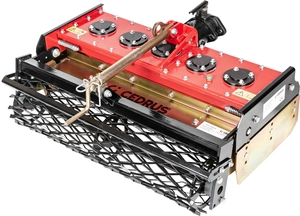
Wheel-driven rotary tiller vs. Inter-row rotary tiller – which one to choose?
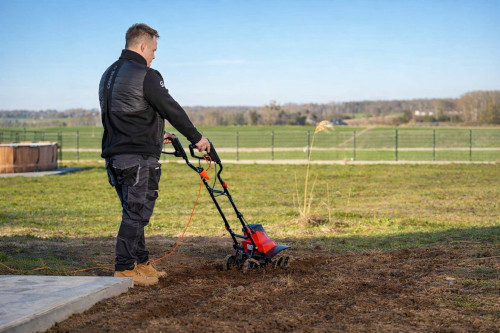
Preparing the soil for growing vegetables, starting a new garden, or running a small farm are tasks that require not only time but also the right tools.That is precisely why so many people, before purchasing gardening equipment, wonder which tiller to choose so that it is suited to the type of soil, the size of the plot, and the nature of the crops they grow.A well-chosen machine can significantly speed up work and reduce physical effort, while the wrong choice often leads to frustration and unnecessary costs.
There are several types of soil-loosening machines available on the market, but two solutions are the most popular: a wheel-driven rotary tiller, designed mainly for larger areas and tougher working conditions, and an inter-row rotary tiller, valued for its maneuverability and precision when tending to plants grown in rows.Although both models serve a similar purpose, they differ in design, handling, and range of practical applications.
The choice between these designs isn't always obvious.The owner of a large garden or recreational plot will have different needs than someone who runs a vegetable garden or a strawberry farm.That is why, before making a purchase, it is worth carefully considering which type of tiller will work best under specific conditions and allow you to achieve the best results with the least amount of effort.
Table of Contents:
- What is a rotary tiller, and what is it used for??
- What are the different types of tillers??
- Wheel-driven rotary tiller vs.Inter-row rotary tiller – how do they differ??
- Advantages and Disadvantages of Wheel-Driven Tillers
- Advantages and Disadvantages of an Inter-Row Tiller
- When Should You Use a Powered Tiller, and When Should You Use an Inter-Row Tiller??
- How to Choose a Tiller That Meets Your Needs?
What is a rotary tiller, and what is it used for??
A rotary tiller is an agricultural and gardening machine whose core component is a rotating shaft with specially shaped blades.Its primary function is to mechanically loosen, aerate, and aerate the soil. Unlike traditional plowing, a rotary tiller does not turn the soil “upside down,” but rather breaks it up and mixes it thoroughly.
It is an indispensable tool for:
- Preparing the soil for sowing and planting.
- Mixing soil with mineral fertilizers, compost, or manure.
- Weed control and soil crust breakdown.
- Restoring Old Lawns.
What are the different types of tillers??
Before we move on to the main comparison of drive types, it’s worth briefly organizing our knowledge about the types of tillers that are generally available at stores like Ewimax.
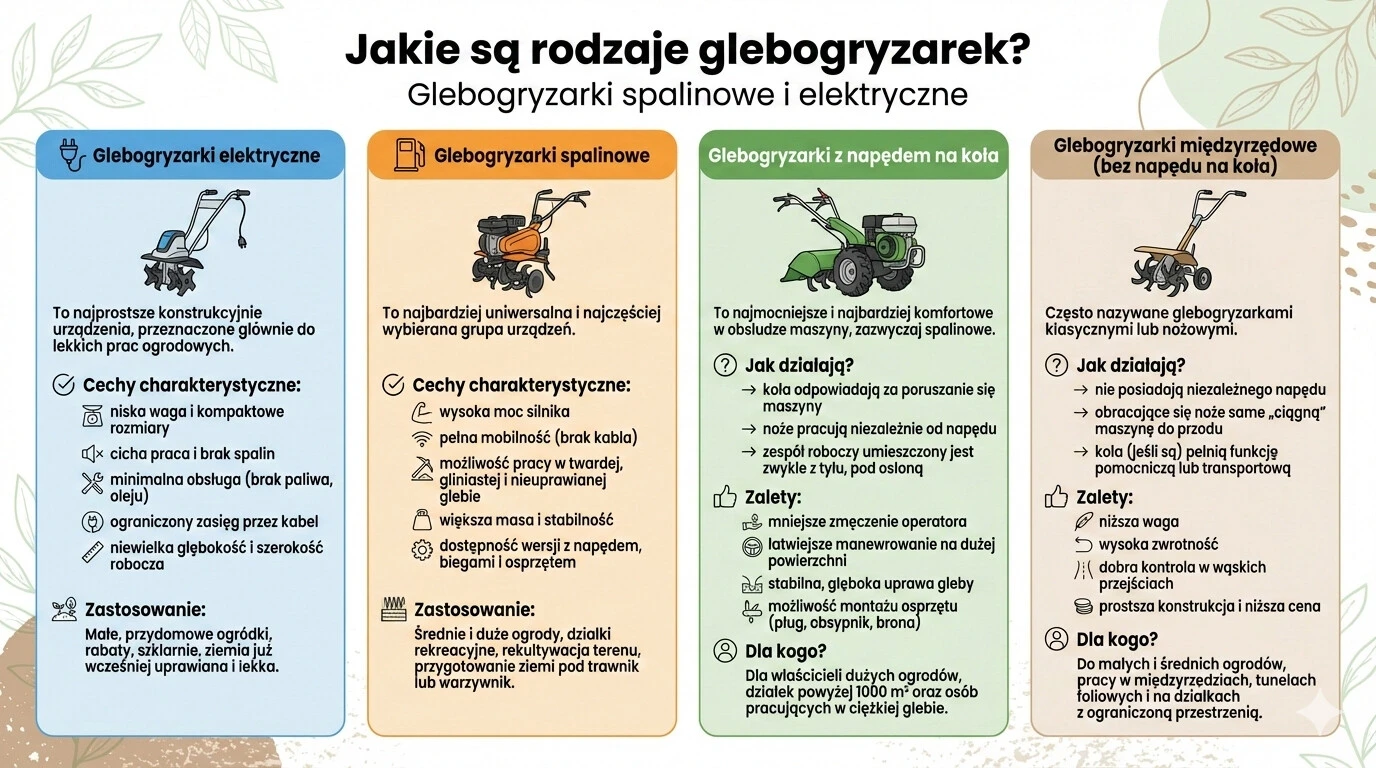
Gasoline and Electric Tillers – A Brief Comparison
Choosing a power source is usually the first step. 's electric tillers are lightweight, quiet, and maintenance-free, but their range is limited by the cord, and their power is sufficient only for shallow tilling in small home gardens with light soil. and gas-powered rotary tillers are, in turn, machines designed for specialized tasks—they offer high power, mobility, and the ability to work in heavy, clayey soil.
Wheel-driven rotary tillers
These are powerful machines (usually gasoline-powered) in which the wheels and blades operate independently.The wheels are used to transport and steer the machine, and the cutting unit is usually located at the rear (less commonly at the front) under a special guard.
Inter-row rotary tillers
Often referred to as rotary tillers without wheel drive (or with blades mounted in place of wheels).In this case, the rotating blades serve as the drive mechanism—by digging into the ground, they “pull” the machine forward.They are generally lighter and more maneuverable than models with independent drive systems.
Wheel-driven rotary tiller vs.Inter-row rotary tiller – how do they differ??
Understanding the key differences between the available types of machines is essential if you're wondering which tiller to choose for your garden, vegetable patch, or small plot of farmland.Although both devices are used to loosen the soil, their design and mode of operation significantly affect the comfort and efficiency of use.
Differences in Design and Construction
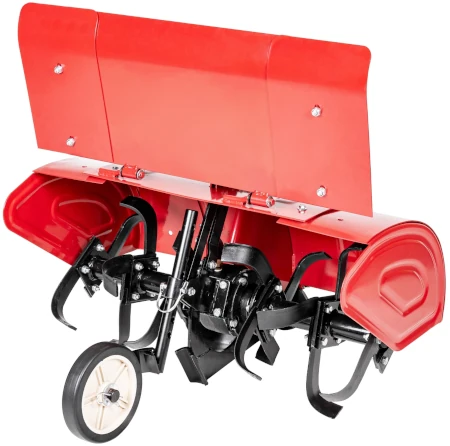
A wheel-driven rotary tiller features a more robust design, which was engineered for use on larger areas and in more challenging soil conditions.Its distinctive features include:
- large, pneumatic tires with a distinct tread pattern (often in a herringbone pattern),
- an independent drive that transmits power to both the wheels and the working shaft with blades,
- greater curb weight, which improves stability during operation,
- a sturdy cutting unit guard that enhances operator safety.
The inter-row rotary tiller features a simpler and lighter design, which directly translates to its agility and ease of maneuvering.In practice, this means that:
- The motor directly drives the shaft with the cutting blades,
- the knives also serve as the machine's drive,
- wheels (if any) are used primarily for transport or stabilization,
- The entire structure is lighter and easier to carry.
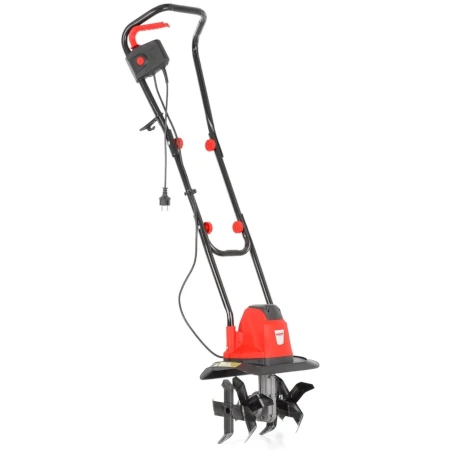
HECHT 732 Electric Tiller - 750W / 32 cm
Differences in how the machine is operated and handled
It is the way the equipment is used that most often determines which type will perform better under specific conditions.
How Does a Wheel-Driven Tiller Work??
- The operator sets the travel speed and working depth,
- The machine moves forward on its own, without needing to be pushed,
- The working blades evenly loosen the soil to a preset depth,
- The stable design prevents the machine from "drifting" sideways,
- The work is less tiring, even on hard or compacted soil.
How Does an Inter-Row Tiller Work??
- Forward motion is generated by the rotating blades,
- The operator actively controls the working speed and the depth of loosening,
- Adjusting the coulter allows you to adapt the intensity of operation to the type of soil,
- in difficult conditions, it requires greater strength and skill,
- provides excellent control in narrow passages and between rows of crops.
Differences in Practical Application
Each of these types works best under slightly different conditions.
Wheel-driven rotary tiller will be a good choice if:
- you work in large, open spaces,
- the soil is heavy, clayey, or has not been cultivated for a long time,
- If you value a high level of comfort at work,
- I need a machine to use as a rotary tiller for a small farm or a large garden.
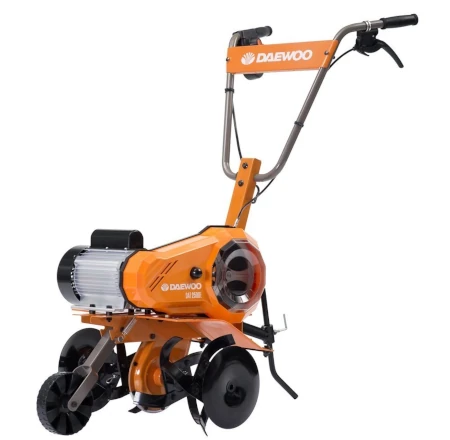
Inter-row rotary tiller works best when:
- you grow vegetables planted in rows,
- you need high precision and maneuverability,
- you work among plants, shrubs, or in a plastic tunnel,
- Are you looking for versatile equipment for regular soil maintenance?.
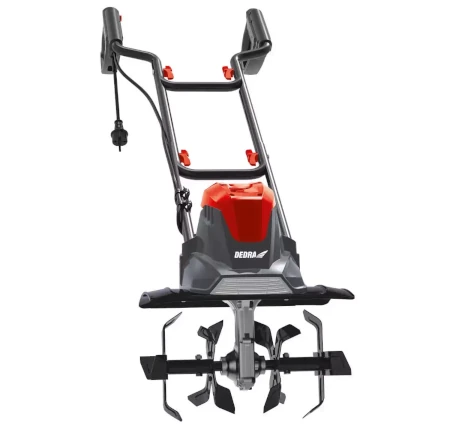
Dedra DED8709 Electric Tiller - 1050W / 36cm
Advantages and Disadvantages of Wheel-Driven Tillers
Rear-drive tillers are high-end equipment, often chosen by professionals and owners of large gardens.
Advantages of a self-propelled rotary tiller:- Minimal physical effort: The machine moves forward on its own; the operator simply steers it..
- Working in heavy soil: Thanks to their heavy weight and wheel drive, the blades can rotate in opposite directions (DRS system), which allows them to break up even very hard, compacted soil.
- Workplace Safety and Cleanliness: The blades, concealed under a sturdy guard, do not fling stones or clumps of soil at the operator’s feet.
- Constant working depth: makes it easier to achieve a perfectly level surface for your lawn.
- Large size: difficult to maneuver in small, densely planted gardens.
- Price: They are significantly more expensive than the mid-range models.
- Complex design: more mechanical components (transmission, differential) mean potentially higher maintenance costs.
Advantages and Disadvantages of an Inter-Row Tiller
This is the most popular tiller for growing vegetables in home gardens.
Advantages of an inter-row rotary tiller:- Unmatched maneuverability: you can literally turn it around on a dime.
- Adjustable working width: You can remove the side sections of the blades to achieve a width of, for example, 30 cm—ideal for use as a tiller between rows.
- Lightweight and portable: easier to transport (often fits in the trunk of a station wagon once the handles are folded down).
- Attractive price: very good power-to-price ratio.
- Strain on the hands and back: the operator must physically “struggle” with the machine in difficult terrain.
- Less stability: On hard surfaces, it may bounce and require multiple passes over the same spot.
- Risk of soil contamination: The blades are generally less covered, which contributes to dust and soil scattering.
When Should You Use a Powered Tiller, and When Should You Use an Inter-Row Tiller??
The decision about which garden tiller is best depends on the nature of your work.
When to Choose a Wheel-Driven Tiller?
This is the best rotary tiller for a small farm or for plots larger than 10–15 ares.Choose this option if:
- You're laying out large lawns from scratch.
- Your soil is clayey, hard, and rarely cultivated.
- You value comfort and don't want to strain yourself while working.
- Do you have a large, open area without dense vegetation?.
When to Choose an Inter-Row Tiller?
This is the perfect tiller for vegetables and plants grown in rows.It will be unrivaled when:
- Do you grow vegetables in rows with varying spacing (e.g., carrots, onions)?.
- Are you looking for a versatile machine? A strawberry rotary tiller requires precise, narrow-range operation, and this model makes that possible.
- Your soil is regularly tilled and is light or moderately compact.
- You have to weave your way through the fruit bushes or in the greenhouse.
- You need a potato tiller (once you add a ridger, these models do a great job of forming ridges).
How to Choose a Tiller That Meets Your Needs?
In summary, before you make a purchase at Ewimax, consider these five key factors.
1.Land area and soil type
For up to 500 m² of cultivated land, a lightweight inter-row machine is sufficient.For areas larger than 1,000 m² or on heavy fallow land—definitely go for all-wheel drive.
2.Type of cultivation – garden, vegetable garden, orchard, plantation
If you're a strawberry grower and need a rotary tiller for strawberries, it's essential to be able to adjust the blades to a width of approx..20-30 cm.Inter-row models are unrivaled here.However, if you're preparing a field for planting grains or large vegetable plots, a wheel drive will spare you the physical strain.
3.Engine power and working width
The rule is simple: the harder the ground, the more KM (horsepower) you need.For widths over 80 cm, a 5-6 KM engine is the absolute minimum required for effective operation.
4.Work Comfort and Ease of Use
Check to see if the handles are adjustable in two directions (up and down, and side to side).The lateral adjustment feature is a godsend on inter-row tillers—it allows you to walk alongside the machine without trampling the soil that has already been loosened.
5.Budget and Frequency of Use
If you plan to use the machine twice a year (spring/fall) on a small plot of land, the between-row model is a cost-effective choice.For professionals and older adults, investing in a wheeled drive system is worth every zloty spent because of the protection it offers for the spine.
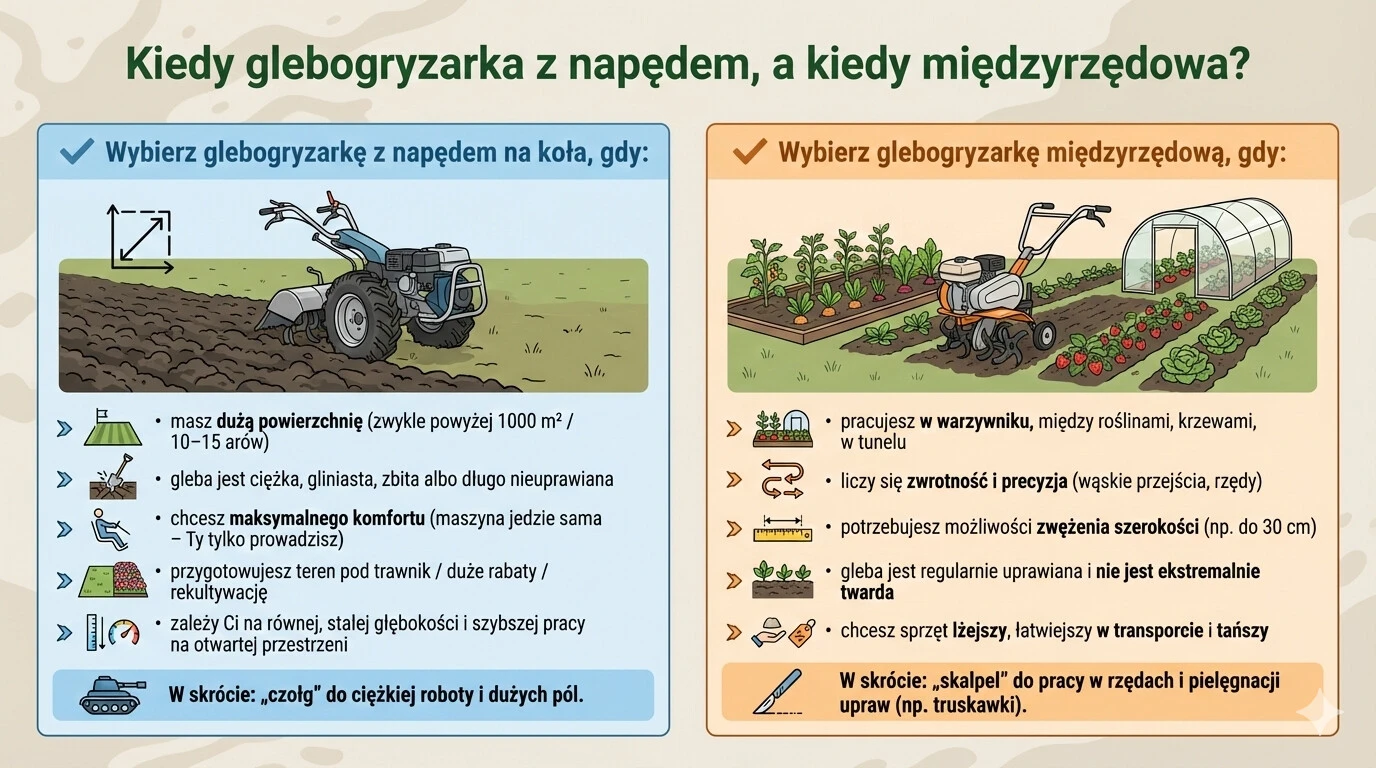
The right gardening tools make your work more comfortable and enhance the appearance of your garden!Therefore, the choice between a self-propelled rotary tiller and an inter-row tiller must be carefully considered.A self-propelled rotary tiller is a "tank" that will prepare difficult terrain without any effort on your part.The inter-row model is a "scalpel" that will allow for precise plant care throughout the season.Find the right one for you at the ewimax store.en!
Recommended
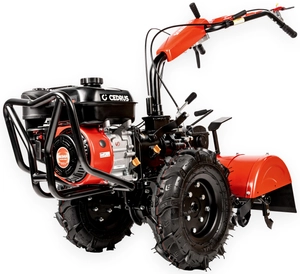
CEDRUS GLX640 SPRINIONAL GARDEN PLOTTILLER 5.5 HP / 62cm Weima 170F/P GLX 640 - EWIMAX - OFFICIAL DISTRIBUTOR - AUTHORIZED DEALER CEDRUS

CEDRUS GL03 PRO-LC SPRINIONAL PLANT-GARDENER WITH DRIVE CULTIVATOR 6.5 HP / 45cm LONCIN G200F GL03 - EWIMAX - OFFICIAL DISTRIBUTOR - AUTHORIZED DEALER CEDRUS
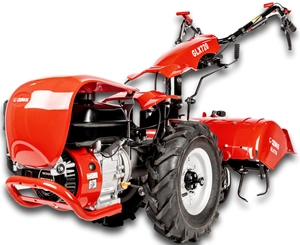
CEDRUS GL11 GLX720 SPRELINER COMPACTOR GLX 720 SELECTORIZER WITH CULTIVATOR DRIVE TRAKTOR SINGLE-SIZE WITH GEAR 72cm / 7HP GL11 GLX720 - OFFICIAL DISTRIBUTOR - AUTHORIZED DEALER CEDRUS